
Overview
The situation for low-income earners has become increasingly dire with recent increases in the cost of living, most notably from late 2021 to early 2023. Millions of U.S. workers are trapped in poverty, and the minimum wage is a powerful tool for tackling the problem. Unlike the federal government, which has frozen the minimum wage at $7.25 since 2009, New York has more than doubled its minimum wage to $16.00 over this same period.
In Tompkins County, the most income-unequal metro area in upstate New York, activists, employers and policymakers have been working since the 1980s to increase the minimum wage to a living-wage level. A living wage covers “basic” expenditures for a single person who lives frugally and does not have to pay for childcare. Starting in the early 1990s, Alternatives Federal Credit Union began calculating a living wage.
Since 2018, ILR School researchers have been supporting local policymakers through research and facilitation. In 2023, the Ithaca and Buffalo Co-Labs wrote a feasibility study to peg the minimum wage to the living wage. Also in 2023, we began calculating the living wage, retaining the Alternatives Federal Credit Union’s basic approach but updating the methodology to use commercial hyperlocal expenditure data available through Cornell’s libraries.
Key Findings
- The 2026 Tompkins County living wage is $25.08.
- In 2025, the living wage increased by 35%, reflecting the rapid cost-of-living increases over the previous two years.
- Wages have not kept up with the cost of living in recent years. While the 2025 living wage was 2.23 times higher than the 2009 figure, the median wage increased by 1.76 times.
- Tens of thousands of workers, just under half of the county’s wage earners, are making less than a living wage. The figure is highest for Black workers (67%) and Latinx workers (58%), compared to 48% for white workers.
- The gap between the minimum wage and living wage has widened from $2.82 in 2021 to $9.08 in 2026.
- The main drivers of the rapid cost-of-living increases from 2023 to 2025 were housing ($1,276 to $1,489 per month) and transportation ($320.02 to $519.98 per month).
- The cost of living is higher in Tompkins County than in the surrounding region and is increasing more rapidly. Since 2009, the Consumer Price Index for the Northeast Region has increased by 45.5%, whereas the Tompkins County Living Wage has increased by 73.8%.
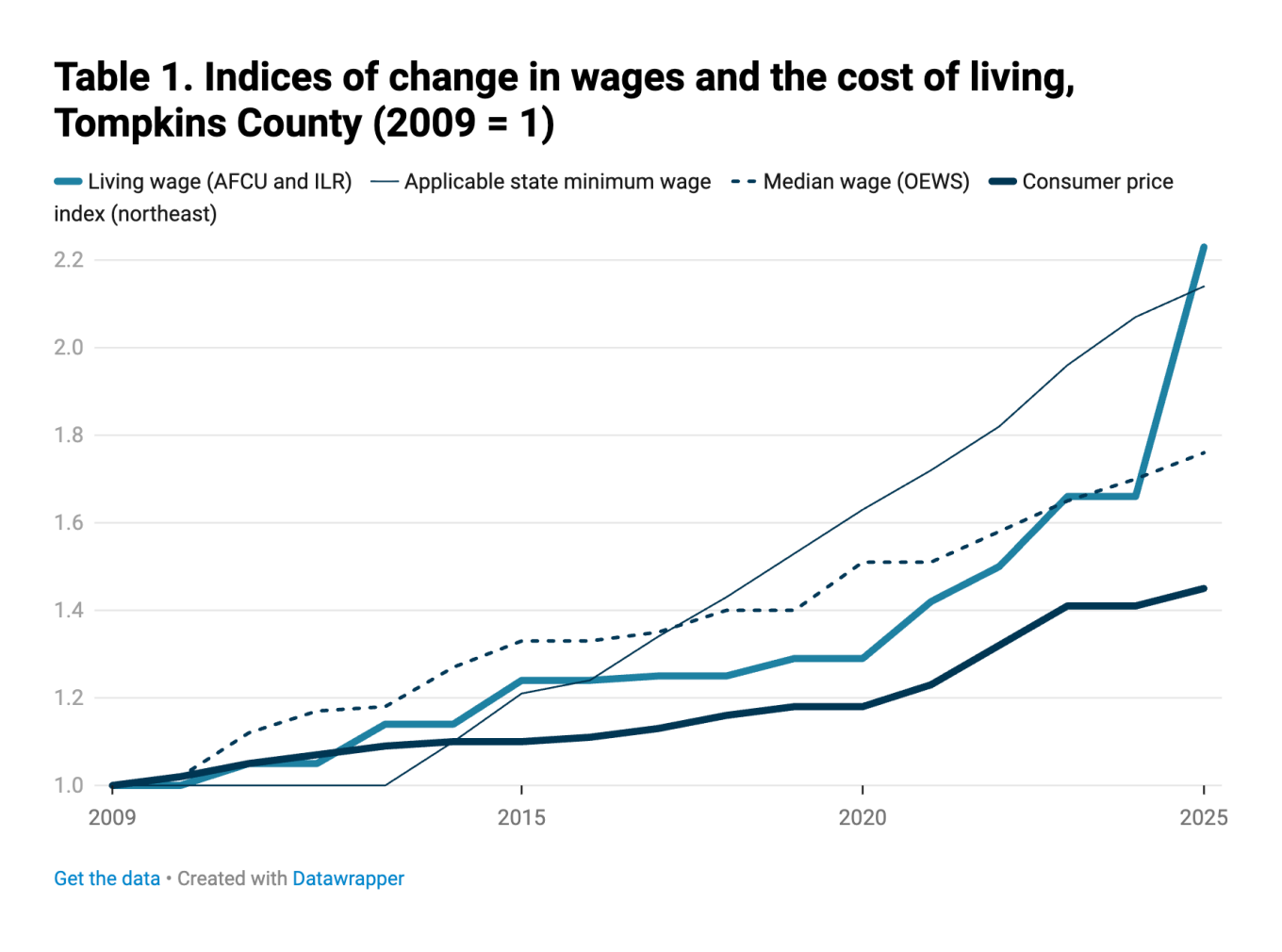
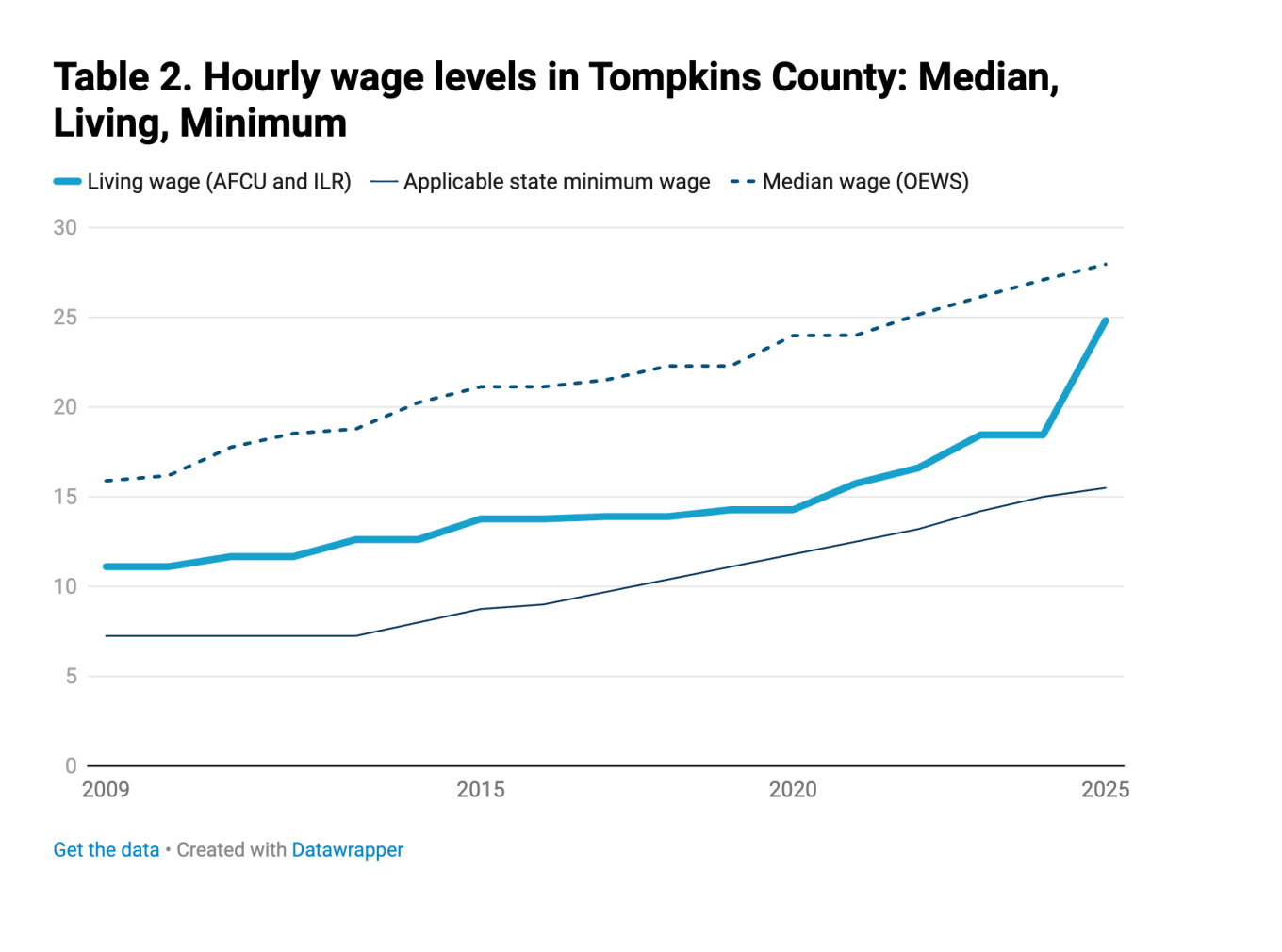
Living wage levels come from reports from Alternatives Federal Credit Union and the Ithaca and Buffalo Co-Lab. Median wages come from Occupational Wage and Employment Statistics from the Bureau of Labor Statistics (BLS). Inflation comes from the Consumer Price Index also produced by BLS. Minimum wage levels come from New York State Department of Labor’s History of the Minimum Wage.
Recommendations
- Policymakers should increase the minimum wage in line with cost-of-living increases, and where the cost of living is higher, the minimum wage should be higher.
- Minimum wage levels should be set with the cost of living in mind, using a high-quality living wage methodology.
Research Impact
Since 2025, the ILR School has published an annual living-wage calculation. This figure is used by a local program to certify living-wage employers, and by activists to demand wage increases from employers that do not pay a living wage. It is also used more broadly by journalists, policymakers and others to understand the magnitude of the low-wage problem. It is frequently cited in debates over whether Tompkins County should have a minimum wage higher than the state minimum wage.
The county has commissioned a study by the ILR School to gather input from stakeholders affected by local minimum wage legislation.
AUTHORS:
Ian Greer, research professor and Ithaca Co-Lab director; Russell Weaver, Buffalo Co-Lab director of research; Wen Li Thian, Ph.D. student

CONTACT:
Cathy Creighton
Director
cathycreighton@cornell.edu
The Buffalo Co-Lab for Economic Development continues to play a leading role in Buffalo’s resurgence with a more equitable economy. By partnering with Western New York businesses, unions, government, education and community organizations, the Buffalo Co-Lab impacts New Yorkers statewide through workplace health and safety programs, economic development and labor research, immersion experiences for students and many other initiatives.

CONTACT:
Ian Greer
Director
icg2@cornell.edu
The Ithaca Co-Lab mobilizes students and research to tackle policy challenges in the local region. These include fighting unemployment, winning a living wage, overcoming disadvantage in the job market and organizing for worker voice in the workplace.