
Overview
In 2025, the Erie County Commission on the Status of Women and the Buffalo Co-Lab at Cornell University’s ILR School conducted a study to determine the extent of a gender wage gap in Erie County, New York, and to make recommendations on how such wage inequities can be addressed and eradicated. Focus groups of mixed-race women revealed workplace experiences that varied, primarily based on race. Thus, from October 2025 through January 2026, the ILR research team dug deeper into the historical data and experiences of Black women in workplaces throughout Erie County.

Key Findings
- Black women in Erie County are two to three times more likely to be impoverished than white women and white men, respectively.
- The unemployment rate for women of color in New York state (5.4%) is more than twice the rate experienced by white women (2.5%).
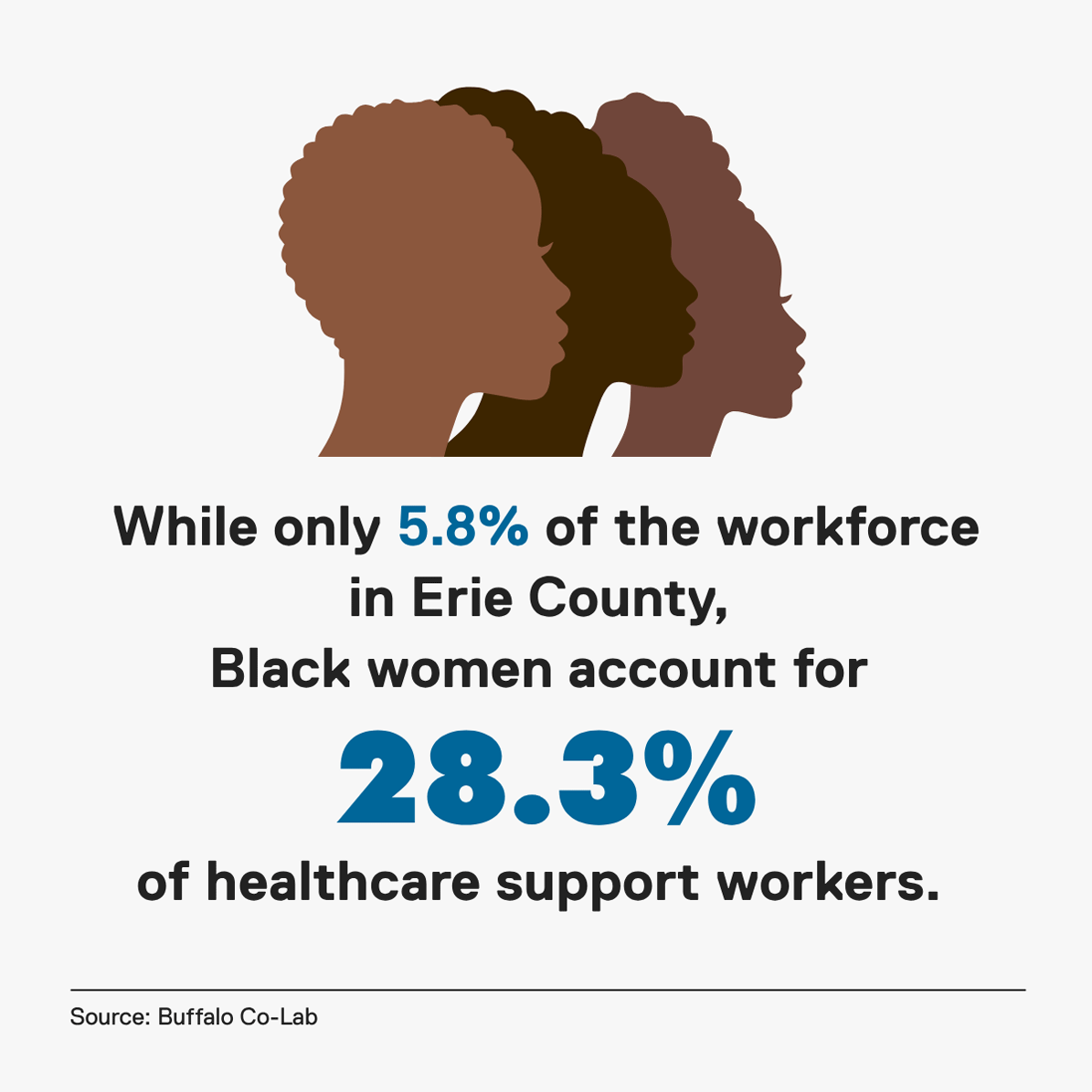
- Black women are concentrated in frontline work in Erie County; while only 5.8% of the workforce, they account for 28.3% of healthcare support workers.
- Black women described their workplaces as benefiting from their labor, expertise and resilience without fully valuing or protecting them.
- Participants reported being overqualified yet underpaid, closely scrutinized and expected to work harder to prove their legitimacy, while navigating racism, sexism, colorism, accent bias and retaliation.
Recommendations
Systemic changes at the national or global level are needed beyond the boundaries of a single county in New York. However, to pursue more immediate progress, our recommendations focus on reform at the organizational level:
- Treat diversity – by race and gender – as a high organizational priority.
- Encourage clear messaging and modeling from leadership.
- Increase pay transparency and pay equity.
- Consistently use clear criteria for evaluation, hiring and promotions.
- Strengthen safe reporting and protections.
- Move beyond performative diversity, equity and inclusion to offer anti-racist training and resources.
- Consider flexible work arrangements.
- Adopt union-friendly policies.
- Invest in retention, not just recruitment.
Research Impact
For the initial launch of the report, researchers were invited to the Black Women’s Equal Pay Day event on July 21, 2026, where they presented their findings and recommendations. Additional municipalities throughout New York state have already approached the research team to conduct similar studies in their regions. A presentation of findings and a related panel will take place on Sept. 10, 2026, in Erie County.
AUTHORS:
Kricky Ksiazek, Buffalo Co-Lab civic researcher and High Road program coordinator; Cathy Creighton, Buffalo Co-Lab director; Russell Weaver, Buffalo Co-Lab director of research

CONTACT:
Cathy Creighton
Director
cathycreighton@cornell.edu
The Buffalo Co-Lab for Economic Development continues to play a leading role in Buffalo’s resurgence with a more equitable economy. By partnering with Western New York businesses, unions, government, education and community organizations, the Buffalo Co-Lab impacts New Yorkers statewide through workplace health and safety programs, economic development and labor research, immersion experiences for students and many other initiatives.