
Overview
For over 20 years, Cornell University’s Empire State Poll (ESP) has taken the pulse of New York state residents’ public opinion. Now administered by the Center for Applied Research on Work (CAROW), the poll has continued to ask many of its general-opinion questions while increasing its focus on work. The result is over two decades of rich data on the issues most important to state residents, their views on the state economy and government, and key indicators of New York’s labor market, among others.
ESP data from 2003 through 2024 illustrates a consistent story: Real household income growth in the state has slowed in recent years, while inflation has risen. These trends appear to have reshaped residents’ priorities toward the cost of living. Meanwhile, respondents’ outlooks on personal and statewide finances have grown increasingly pessimistic, and trust in institutions has declined. At the same time, the structure of work has shifted, with the rise of gig workers and a decline in average hours worked after the pandemic.

Key Findings
Since the pandemic, cost of living has been the top concern of New York residents.
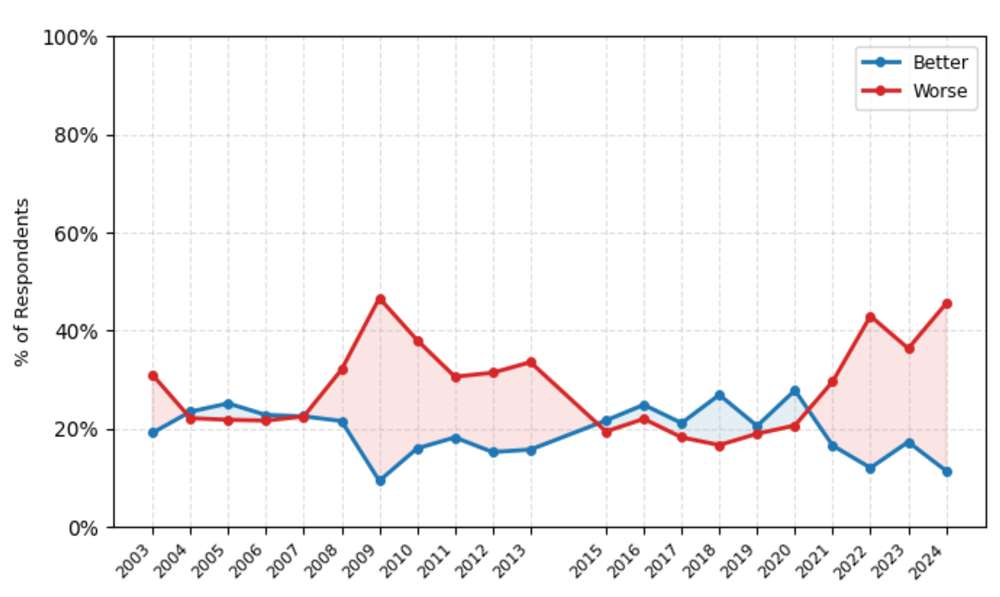
Financial Outlook Over Time
How are you doing financially compared to the previous year?
- The average household income for New Yorkers has risen by nearly 68% since 2007, but after adjusting for inflation, purchasing power has gone up by just 14%, mirroring national wage stagnation.
- The main public concern has shifted over time, with the cost of living being top of mind for respondents since the pandemic.
- Economic pessimism has grown and coincides with lower trust across all institutions studied. Trust in unions has proved somewhat more resilient than that in other institutions, however.
- Union membership and gig work (23% and about 13% in 2024, respectively) remain notable features of New York’s labor market.
Research Impact
Taken together, the findings outlined in this report point to steps policymakers and organizational leaders can take to address the economic anxiety New York residents are experiencing:
- State policymakers can take measures to ensure the minimum wage aligns with living wage estimates, expand and strengthen programs that support basic needs like housing and childcare, and strengthen the unemployment insurance system to ensure that more vulnerable individuals are eligible. It is also crucial to work with local and community leaders to address local-level issues.
- Employers can also take steps to address residents’ anxieties by providing cost-of-living adjustments that keep pace with inflation and exploring options to bolster benefits for programs such as childcare, transportation and savings.
- Businesses and local governments should invest in transparency and communication initiatives to rebuild the public’s trust.
- The media can highlight the erosion of worker protections and counter the perception that hardship is the individual’s fault.
AUTHORS:
Anne DeCecco, CAROW senior research & policy development associate; Stella Ma, CAROW research aide; Russell Weaver, Buffalo Co-Lab director of research; Phumthep Bunnak, former CAROW research aide

CONTACT:
Ariel Avgar
Director
aca27@cornell.edu
The Center for Applied Research on Work exists to connect research on work with the practice of putting it to use. We support member institutes and affiliated faculty and students in their efforts to take insights about work, labor and employment and share them broadly. We are uniquely placed to seed innovative research that puts academic study into practice.