
Overview
The national care crisis is sharply visible in New York. Those caring for family and loved ones are straining under the weight of unpaid caregiving, while support for care remains unaffordable and difficult to access; at the same time, there is a shortage of paid care workers, who endure devalued, underpaid jobs.
This brief presents an analysis of data on unpaid caregiving and its impact on New Yorkers’ paid employment from the 2024 Empire State Poll. The findings affirm that caregiving – both unpaid caregiving and access to paid care support – remains a pressing concern for a substantial number of New Yorkers providing care for children and/or adults. Caregiving respondents widely report the toll caregiving takes on their ability to do paid work, with the highest costs reported by people of color and women. The lack of affordable care support stands out as a significant barrier to employment.
Key Findings
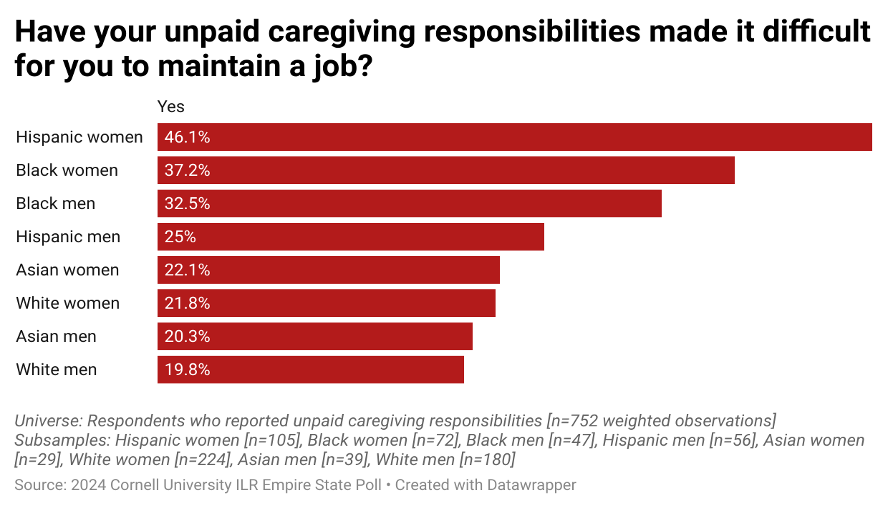
- More than a quarter (26.9%) of all caregiving respondents said their caregiving responsibilities made it difficult to maintain a job, with Hispanic (38.8%) and Black respondents (36.9%) reporting this challenge at significantly higher rates. These findings were even more pronounced for Hispanic women (46.1%) and Black women (39.7%).
- More than one-third of caregiving respondents reduced their paid work due to their unpaid caregiving responsibilities, with women, Hispanic and Black respondents disproportionately affected.
- Among respondents who reduced their paid work due to unpaid caregiving responsibilities, the most common reason reported was that care was unaffordable.
Recommendations
- Ensure universal access to childcare, long-term care and paid family leave policies to bolster people’s agency in determining how much time they spend on caregiving and paid work.
- Strengthen worker representation and voice to establish workplace policies for paid leave and caregiving flexibility, as well as higher pay and job security, to enable people to have more agency in their care choices.
- Efforts to expand the care workforce must prioritize securing more dignified pay and working conditions for care workers.
Research Impact
A range of changes recently enacted by the Trump administration threatens to sharply aggravate the crisis of care. Major cuts to Medicaid, the targeting of immigrants and the rollback of important worker protections threaten to reduce access to care and to put the care workforce at risk. On the whole, such changes are likely to increase reliance on unpaid caregiving, intensifying the strain families already bear. Within this context, the findings of this research reinforce the urgency of state- and local-level policy responses that recognize and support unpaid caregiving, make care more affordable and accessible, and provide dignified pay and working conditions for caregiving jobs.
AUTHORS:
Zoë West, Worker Institute senior researcher; Michael Lenmark, Worker Institute survey statistician

CONTACTS:
Patricia Campos-Medina
Executive Director
pec1@cornell.edu
Risa Lieberwitz
Academic Director
rll5@cornell.edu
The Worker Institute engages in research and education on contemporary labor issues to generate innovative thinking and solutions to problems related to work, economy and society. The institute brings together researchers, educators and students with practitioners in labor, business and policymaking to confront growing economic and social inequalities, in the interests of working people and their families. A core value of the Worker Institute is that collective representation and workers’ rights are vital to a fair economy, robust democracy and just society.