
Overview
As separate groups, people with disabilities and justice-impacted individuals face significant barriers to work. They are among the most likely to be underemployed or unemployed, or to exit the labor market early. This is true both nationally and in New York, where each group has extremely low employment rates compared to the general population.
These groups are often thought of as separate service populations, but there is substantial overlap. Collaborative research by the Criminal Justice and Employment Initiative and the Yang-Tan Institute on Employment and Disability has explored the need for intersectional approaches to serving New Yorkers with disabilities and justice-system involvement as they pursue employment.
One key consideration is state vocational rehabilitation (VR) programs, which provide people with disabilities support in achieving employment outcomes. Justice-impacted groups are a special service population in the VR program, but our analysis found they are underserved in New York. Additionally, corrections agencies need to increase appropriate referrals and wraparound services during the reentry process.

Key Findings
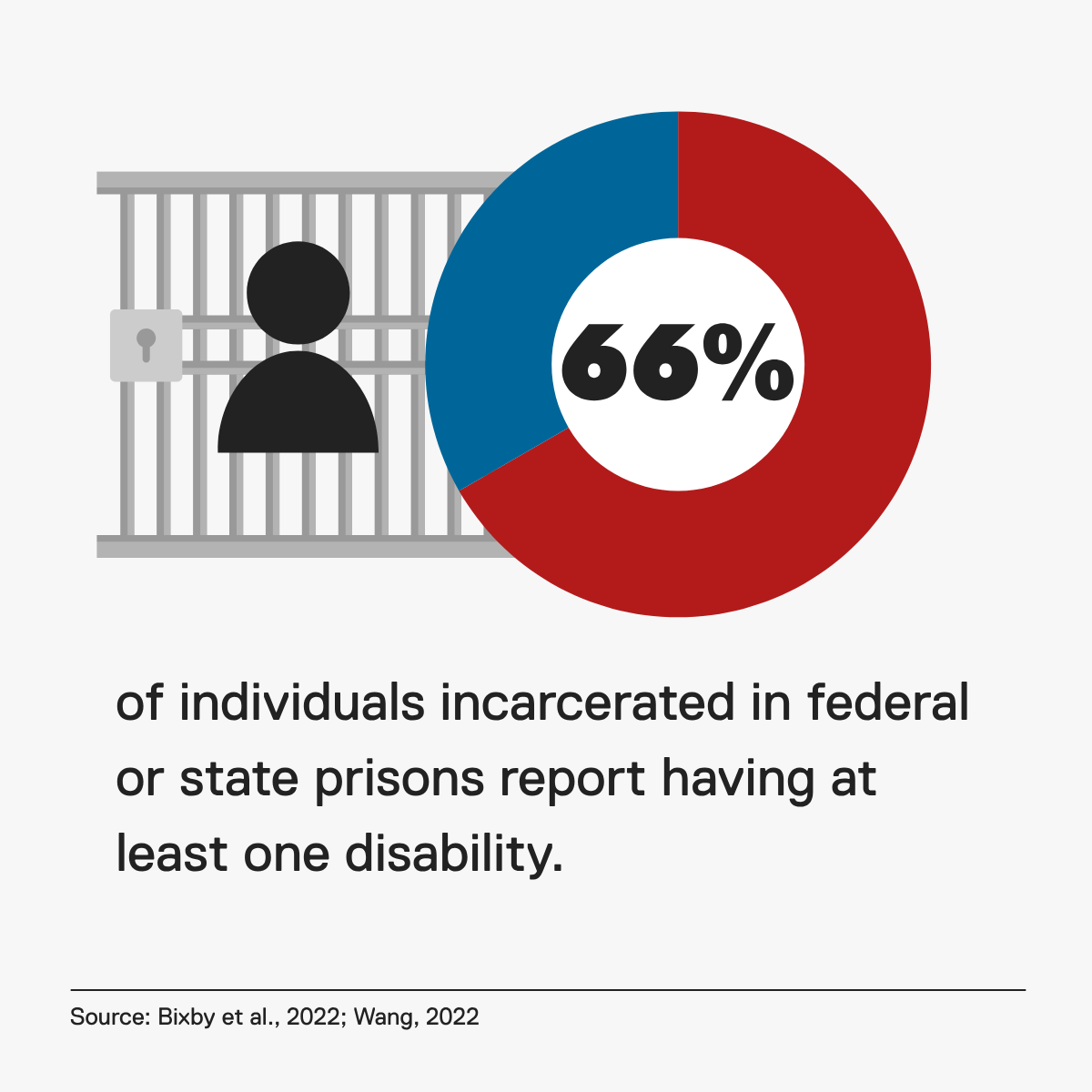
- Sixty-six percent of people in federal and state prisons report having at least one disability.
- Our research found that 26% of people with disabilities experience some type of justice-system interaction, a rate that far exceeds that of people without disabilities.
- As separate groups, employment rates are low for people with disabilities (about 45%) and people with prior convictions (about 40%).
- Our research provided clearer estimates of the intersectional impact, finding that employment rates for justice-impacted people with disabilities are only 39%, compared to 45% for people with disabilities and no prior justice-system involvement.
- Our analysis of New York VR data found that people with both disabilities and prior justice system involvement exited VR services with lower success in achieving employment (21% vs. 27%) and lower rates of “measurable skills gains” (7% vs. 15%).
- Rates of referral between corrections and VR agencies are also extremely low.
Recommendations
- To improve coordination between systems, New York should remove the “six months from release” criterion from VR policies and implement required frameworks for delivering VR services in carceral settings.
- New York should follow other states’ statutory examples outlining requirements that VR services options be exhausted for incarcerated individuals with disabilities prior to placement in corrections-operated vocational programs.
- New York should ensure that sufficient interagency agreements are in place between corrections and other key agencies serving people with disabilities.
- New York should develop regulatory and other policy frameworks that establish procedures for submitting VR applications, facilitate access to carceral settings for vocational rehabilitation counselors (VRCs) and ensure appropriate referral to VR for individuals under community supervision.
Research Impact
We have delivered training and technical assistance to create impact across stakeholder groups and improve interagency coordination around the state.
These include:
- Training sessions for law enforcement and justice system personnel in collaboration with the New York State Office of People with Developmental Disabilities (OPWDD) Justice Center
- Continuing Legal Education (CLE) training sessions for public defenders, district attorneys, magistrates and probation officers
- Technical assistance and training for state VR and workforce development professionals
- Training and technical assistance delivered to justice-impacted New Yorkers as they navigate employment challenges related to their disability, their criminal record or both
AUTHORS:
Matt Saleh, Criminal Justice and Employment Initiative senior associate director, Labor and Employment Law Program; Jen Brooks, Yang-Tan Institute on Employment and Disability research associate

CONTACT:
Matt Saleh
Senior Associate Director
mcs378@cornell.edu
The Criminal Justice and Employment Initiative improves employment opportunities for people with criminal records by designing and delivering legal employment training to close information gaps, implement best practices and integrate job seekers with criminal records into the workforce.

CONTACTS:
Susanne Bruyère
Academic Director
smb23@cornell.edu
Wendy Strobel Gower
Thomas P. Golden Executive Director
ws283@cornell.edu
The Yang-Tan Institute on Employment and Disability works to advance the inclusion and full participation of people with disabilities in the workplace and community. Our research, training and technical resources expand knowledge about disability inclusion, leading to positive change.