Bigler Shares Fair Chance Hiring Best Practices with N.Y. Lawyers
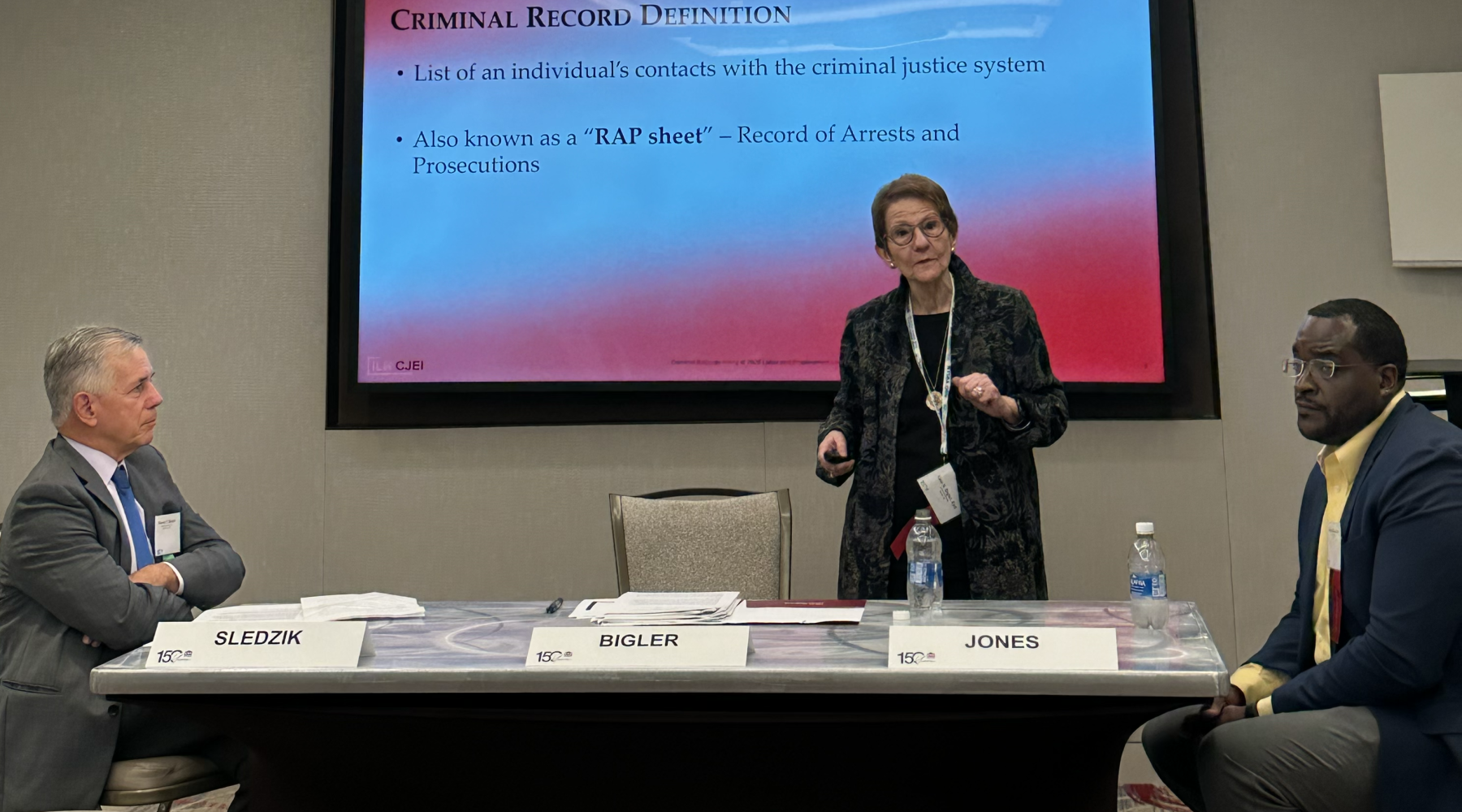
Esta Bigler, director of Labor Law and Employment Programs at the ILR School, presented on the topic of fair chance hiring at the New York State Bar Association’s Labor and Employment Law Section fall meeting, held in Ithaca earlier this month.
An audience of nearly 25 lawyers attended the presentation, where they learned how ban-the-box rules, the federal Fair Credit Reporting Act, New York Correction Law 23-A, the New York State Human Rights Law, the Clean Slate Law, and the Marijuana Regulation and Taxation Act all affect employment decisions.
“Many labor and employment lawyers have never even heard of some of these laws,” Bigler said. “Our purpose was to educate attorneys, whether for their own practice or as they provide counsel to their clients about hiring justice-impacted individuals.”
Bigler emphasized that criminal-record status is protected under New York State law and that employers must evaluate candidates through the required legal steps rather than rely on assumptions about felony or misdemeanor convictions.
Roughly 2.1 million New Yorkers have a criminal record, with approximately 86,700 individuals on probation or parole supervision.
The presentation was based on a previous eCornell Keynote, Hiring and Retaining the Justice-Impacted, in which Bigler and Jodi Anderson Jr., director of technological innovation at the Criminal Justice and Employment Initiative, educated HR professionals on building stronger, more inclusive workplaces by hiring and retaining employees with criminal records.
Joining Bigler for the current presentation was Thomas Jones, education associate at the Criminal Justice and Employment Initiative. By sharing his personal experience with the justice system, he conveyed the broader message that justice-impacted people can be strong employees and should be evaluated as individuals whose circumstances and lives may have changed.
“Thomas has a felony, and when people hear that, their biases come out, and they immediately assume the worst,” Bigler said. “By having him speak candidly about what he did, it helps show that, beyond the legal obligations, there is a human being who has changed and developed over time. He’s not the same person he was when he was 23 years old and arrested.
“The goal of our presentation was twofold. One is to share the law and explain how it needs to be applied, but the second purpose is to make clear that this is a group of people who can make good employees if given the chance.”