Get to Know: Claire Daviss
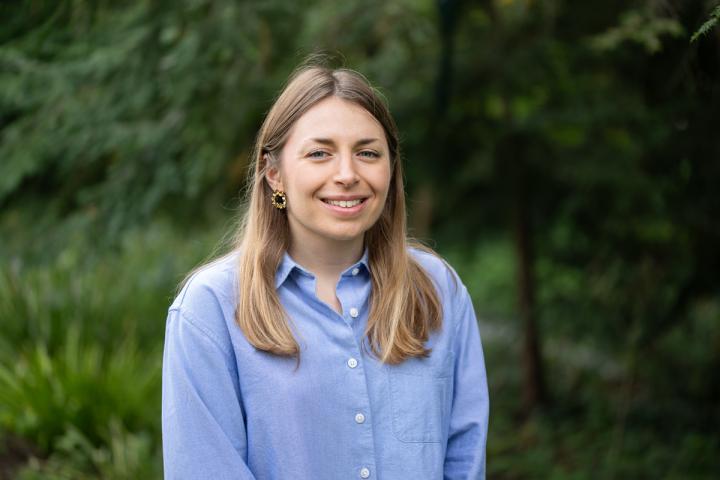
Claire Daviss joined the ILR faculty in fall 2025 as an assistant professor in the Department of Organizational Behavior. Motivated by questions she encountered when working at think tanks earlier in her career, she has embarked on a scholarly life, asking, “Does how we hire affect whom we hire?” She hopes her research into how workplaces contribute to inequality will lead to real-world solutions.
What is your research about?
I am a sociologist who focuses on labor markets, organizations and gender inequality. My research sheds light on how structural features of hiring processes, jobs and organizations shape social inequality in labor market outcomes. My recently published research has covered related topics, such as the influence of remote work on motherhood penalties in hiring decisions and the effect of employers’ interactions with workers on their gender preferences in hiring. In ongoing work, I ask: does how we hire affect whom we hire? More scientifically speaking, I am investigating how the design of hiring processes moderates the influence of gender, race and other social category biases in hiring decisions.
A key part of my research agenda is to harness data sources that are new or underutilized and can potentially lead to breakthroughs. For example, like many scholars, I use online survey experiments to study hiring inequality, recruiting participants to rate fictional job application materials. In recently published work, my collaborators and I developed an experimental tool to collect so-called “digital trace data” from participants in these online surveys, which allows us to monitor participants’ mouse movements and click behaviors while they look at experimental stimuli. Our research using these tools has deepened our understanding of gender bias in hiring decisions. I also expect that collecting behavioral data will be increasingly popular as scholars seek to beat the bots that now frequently plague online research.
How did you become interested in your field?
I started my professional career working at think tanks in the Washington, D.C., area, including several years at the Aspen Institute Economic Opportunities Program. A lot of our focus was on the links between labor markets and social and economic inequality. But I often felt like we encountered more questions than answers, which made it hard to inform business leaders and policymakers. I wanted to be part of the community of scholars answering these questions, and through some soul-searching conversations with folks in a range of occupations, I became inspired to apply to sociology Ph.D. programs. I was honored to be accepted into the sociology Ph.D. program at Stanford. My time there further shaped my interests in labor markets, organizations and inequality – especially gender inequality. I continue to believe that academic researchers have important roles to play in understanding the causes and consequences of labor market inequality, and I aim for my work to offer theoretical, empirical and practical contributions.
What impact do you hope your research will have?
As a society, we have a lot of work to do. We know that gender and racial inequality persist, and we know that a lot of that inequality gets produced inside organizations. But there are still a lot of unanswered questions about exactly how that happens. My research can help us to tease apart those mechanisms, revealing the ways that organizational policies and practices contribute to social and economic inequality. By investigating these mechanisms, we can also develop solutions, enabling organizations to achieve their strategic goals and build meritocratic and inclusive workplaces for their employees.
What attracted you to the ILR School?
I was thrilled to join this rich community of students, scholars and advocates, diverse in our backgrounds but unified in our commitment to the study of work. It is immensely inspiring to have such a range of disciplinary traditions under one roof – sociologists, organizational psychologists, management scientists, labor economists, labor historians, legal scholars and so on. Already, I have benefited from generative conversations with scholars across disciplines, sharpening my thinking and sparking new questions. I am particularly honored to be part of the Organizational Behavior department, which is filled with brilliant and kind scholars whose work I have long admired. And I am eager to get involved in the multiple centers at the ILR School that facilitate research on workplace policies and practices that promote fairness and inclusion, such as ILR WIDE. I can’t imagine a better place to pursue my research and teaching goals.
What are you most excited for about your time at ILR?
I am excited to work with ILR students, our future leaders! I hope that through my teaching and mentorship, I can help to inspire their interest in the social science research that uncovers the causes and consequences of labor market inequality. I also aspire to find opportunities to work more closely with the ILR alumni community, who are today’s leaders! I am eager to learn from them, understanding their current hiring practices and the challenges they face in creating fair and inclusive workplaces. I expect these conversations will inspire new research. And perhaps through collaboration, we can figure out new strategies for success.
If you could share one piece of advice with your students, what would it be?
Give yourself some breathing room! Leave space in your schedule to go for a walk, listen to music, play board games, learn about your roommates’ lives, volunteer in your community or try a new sport. These kinds of unstructured and informal activities aren’t always “resume worthy,” but they will enrich your life, give you energy and maybe even spark some big, creative ideas.