Thousands of Benefits Planners Is Ray Cebula’s Legacy
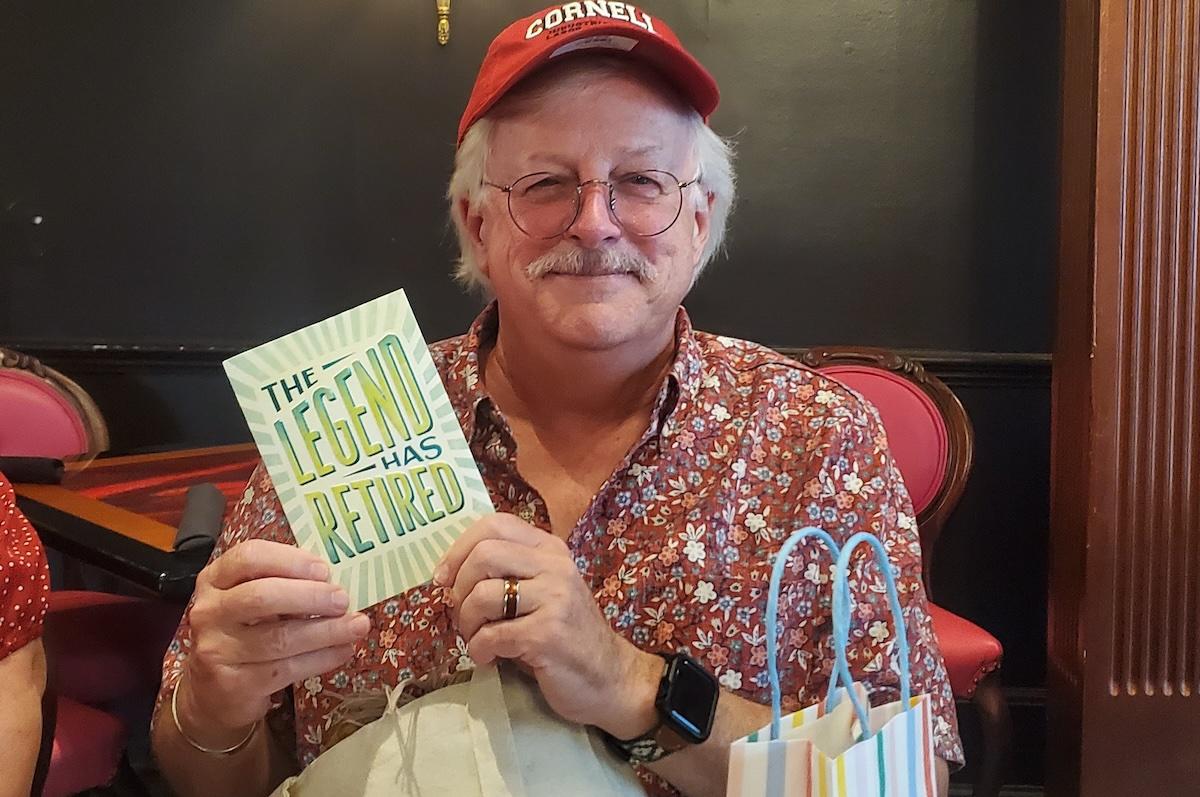
Raymond “Ray” Adam Cebula III recently retired from the ILR School having directed the Work Incentive Support Center – a training program where adult learners can earn professional credentials in work incentives planning – for over two decades. Work incentives planners assist workers with disabilities as they navigate complex rules related to government benefits and healthcare eligibility. The Work Incentive Support Center is housed at the Yang-Tan Institute on Employment and Disability.
We caught up with Ray shortly before he retired to ask about his career and legacy.
Early in your career, you worked as an attorney with the Protection & Advocacy for Beneficiaries of Social Security agency. What was that like?
I handled a case for a gentleman who suffered a traumatic brain injury. I would talk with him, and he would head home to find that he couldn’t remember much of the conversation. So, we had the conversation again. Fortunately, his memory improved during the time we worked together. The Social Security Administration had decided his work was outside its tolerances and charged him with a $16,000 overpayment.
Researching and preparing briefs made me feel stronger about this case. Seems like this part of the law hadn’t made its way before the courts. We lost at the Administrative Law Judge hearing and the Appeals Council. I filed the matter in federal court and argued before the court. Within two weeks, the judge issued a fully favorable decision. In fact, when the benefits were fully calculated and work incentives were applied, my client received $14,000 because he had been underpaid.
My thought … how many other underpaid people are out there?
Why did you begin working for the ILR School’s Yang-Tan Institute on Employment and Disability?
I was working at the Disability Law Center before coming to Cornell, supervising a unit that provided training and technical assistance to other advocates and attorneys across the Commonwealth of Massachusetts. This work fed court-worthy issues to me, and I took advantage of that!
I loved appearing in federal court. But I was feeling a stronger pull to training activities.
During my initial work with Cornell, I was managing a caseload, providing technical assistance to legal advocates. Hearing their success stories excited me.
Push came to shove, and I decided I was ready to make the leap into the academic world. It became a “happily ever after” story.
Your work at ILR focused on the Work Incentive Support Center. What is that center about and why is it important?
It is critical that individuals with disabilities find their place in the American workforce. Those who receive disability benefits need assistance to balance declining benefits with increasing earnings in order to reach financial independence. When provided with knowledge and planning, a new worker can approach work with more confidence and the knowledge that, should something go wrong, there might be someone they can talk to about remedies.
You have been involved with the National Association of Work Incentive and Benefits Specialists (NABWIS). What was your most important contribution to this organization?
NABWIS was co-founded by Thomas Golden [late director of the Yang-Tan Institute]. He signed me up as a member. After a short time, I ended up serving on the Board of Directors and then became its president. During my tenure, we began commenting on proposed Social Security regulations dealing with work incentives and supporting legislation aimed at improving U.S. disability programs. We ventured into the national conference world and have since held eight or nine national conferences that bring together hundreds of planners.
NABWIS has become a known quantity with the Social Security Administration, and my efforts to have SSA staff address our conferences have played a part in this.
What was it like to win the Thomas P. Golden Distinguished Service Award from NABWIS?
It was completely a surprise. Thomas may have been my boss, but he was a dear friend. This meant the world to me.
Bottom line, it let me know that I had an impact and helped a few people along the way.
What were some of your favorite professional moments at ILR?
Part of my duties was to increase the number of tuition-paying students. In the early days, I didn’t know how to do that. Thomas and I were at a conference. The day was ending, and Thomas asked me if I was attending the networking session. I said, “No, I usually go up to my room and use this time for catching up with email.” He chuckled and said, “Not tonight.” He told me to go clean up and come back down, and that he would bring me three contracting opportunities before the night was over.
The on-campus Yang-Tan Institute staff retreats were also wonderful. They were reminders that I was a part of something much bigger. This big room, full of people, all helping workers with disabilities succeed. Now, how many ways does YTI do that? A bunch!
You worked closely with Edwin Lopez-Soto, who retired from ILR in 2024. How would you describe your working partnership with Ed?
We were a team. A killer team. The “Ed and Ray Show” had a very long run. We both came from the same legal services and litigation backgrounds, and we knew how each other thought. We actually did finish each other’s sentences. We both fully trusted and respected each other. He was the perfect work partner.
I will remember forever the last weeklong training in New York City that occurred just before he left us, for a bit, to work with the Rochester City Schools [in the early 2000s]. We worked hard all day. I bought him dinner because he was leaving me. The second night, he bought me dinner because he was leaving me. The rest of the week followed that trend. I remember telling him, “You give me 5% of your time and keep your toe in the YTI door so you can come back!” He did, and we worked together until his retirement!
What was the highlight of your career?
There wasn’t one, but to list a few: Successful cases that impacted every disabled worker with SSA benefits, seeing my client stand with Vice President Al Gore explaining just why SSA’s complete termination of immigrant workers’ benefits was wrong on so many levels, and successfully negotiating settlements with SSA counsel.
Also, hundreds of in-person weeklong trainings with my buddy, Ed [Lopez-Soto]. The years with him were some of the finest!
I think my last day on the job, Sept. 30, will be the highlight of my career. A little kid from Dracut, Massachusetts, became an attorney who decided to help those in the most need. He became a faculty member at YTI. Who’da thunk? He retired at age 70, after a successful 46-year career. And I actually did help a few folks along the way.
That will be my highlight.
What’s on your retirement “things to do” list?
First, sitting in my new weatherproof rocker with my Kindle, a full Cornell YETI wine cup and my four dogs, enjoying the New Mexico sunshine. That’ll do it for a while. Once Kevin is out of school for the summer, I’m hopeful of taking a river cruise from the shores of the Black Sea up the Danube to Vienna, with a short side trip to Prague. Then coming home and enjoying my home and family. A simple life in the desert will do me well.
What will you miss the most about your job?
The people. I already miss them. I can’t say it’s easy having your tasks delegated to someone else, but it’s part of the deal. I have had the opportunity to work with so many brilliant professionals who share my outlook and who care deeply about their work and its impact on the disability community. And laughing with them all.
As you head into retirement, what are your thoughts about your legacy?
My legacy is clearly every benefits planner who I have had the honor of training continuing to help people with disabilities return to work. After I received the Thomas Golden NABWIS award, I looked out over the audience and told them, “My legacy is each and every one of you who do this good work.”