“Labor in New York in 2026” Presented in Albany
Hosted by New York State Chairs of the Committee on Labor Senator Jessica Ramos and Assemblymember Harry B. Bronson, this program featured experts from Cornell University’s New York State School of Industrial and Labor Relations (ILR). Founded in 1945 to address the great workplace conflicts of the time and to promote better labor-management relations, ILR continues to be the world’s leading school focused on labor, management and the economy.
“There are such great ideas here,” said Bronson. “The work you do is wonderful, and I am glad that the legislature is able to take the lead in supporting this vital work that keeps our state and our communities informed.”
Members of ILR Outreach presented research on a series of topics that directly affect employers and employees in New York.
“We have real champions in Albany,” said Diane Burton, senior associate dean for research, outreach and external relations. “We have real supporters who know the value that we bring. They were happy to see the progress reports, and they are eager to continue to work with us.”
Below are summaries of the presentations and links to a Dropbox of additional resources.
AI AND THE FUTURE OF WORK
Alexander Colvin, Ph.D. ’99, the Kenneth F. Kahn ’69 Dean and the Martin F. Scheinman ’75, MS ’76 Professor of Conflict Resolution at the ILR School, Cornell University. ajc22@cornell.edu
The rapid expansion of AI is the latest major wave of technological change affecting the workplace, with the potential to cause widespread change and disruption. Technology can have productivity-enhancing effects, while also displacing many existing jobs. Companies may use AI as a technology that replaces skilled labor, displacing jobs and downgrading the remaining work. It is critical that public policy seeks to avoid this path and instead promote high road uses of AI technologies that combine its potential productivity benefits with higher quality jobs.
Public policy response to support a high road approach:
- Active labor market policies:
- Enhance unemployment insurance protections for displaced workers.
- Strengthen the New York State Worker Adjustment and Retraining Notification Act.
- Enhance worker bargaining power:
- Reinforce union and collective bargaining rights.
- Ban non-compete agreements.
- Avoid low road competition:
- Strengthen the minimum wage.
- Enforce employment standards.
Read more about AI and robots in fulfillment centers, Worker Voice and AI in the Workplace, AI and the Fashion Industry, and AI and HR.
CONTRACT AND GIG WORKERS
M. Diane Burton, the Joseph R. Rich ’80 Professor of Human Resource Studies, senior associate dean for research, outreach, and external relations, and director of the Institute for Compensation Studies. burton@cornell.edu
As the demand for last-mile delivery services continues to increase, parcel delivery has become one of the fastest-growing jobs in the U.S.
Gig Work
- Between 25% and 43% of the U.S. workforce participates in gig or non-standard work.
- As of 2025, at least 42 million people in the U.S. engaged in some form of gig work.
- One in 10 workers rely on gig work for their primary income.
Last-Mile Delivery
- E-commerce continues to fuel demand in this heavily concentrated industry.
- Parcel delivery is a fast-growing occupation, but one with declining wages and eroding job quality.
- 22.4 billion packages were shipped in the U.S. in 2024.
- The average American household received 167 packages in 2024.
- Four organizations handle more than 90% of all domestic shipments and net more than 95% of market revenue (USPS, UPS, FedEx, Amazon).
Policy Considerations
- Industry: anti-trust, franchising law, disclosures, consumer protection, taxation/subsidies.
- Transportation: vehicle regulations, safety training, insurance mandates, parking restrictions, congestion pricing.
- Data: data sharing, privacy rights, transparency.
- Workers: joint employment, minimum wage, worker protection.
UNEMPLOYED AND UNDEREMPLOYED
Michèle Belot, Frances Perkins Professor of Industrial and Labor Relations and Professor of Economics. mb2693@cornell.edu
The Cornell Job Search Lab, part of the Labor Dynamics Institute (LDI) at Cornell, unlocks digital tools to help support the process of labor market transitions in response to changes in the economy. The LDI algorithm leverages data (administrative and résumé databases via platforms) on past career transitions, linked with a large amount of data on successful labor market transitions, to identify ‘sensible’ occupations to recommend for those who have difficulties finding a job in their preferred occupation.
In controlled trials, job seekers were:
- 30% more likely to have job interviews (via online platform, Edinburgh).
- 30% more likely to find a stable job (via online platform, UK).
- 5.2% more likely to be employed (via email, Netherlands); job seekers considered “long term unemployed.”
Cornell has developed an online Job Search Studies Database.
Learn more about Job Seekers in Edinburgh, Advice to Job Seekers and Impact of Advice from Online Search for the Long Term Unemployed.
JUSTICE-IMPACTED WORKERS AND CLEAN SLATE
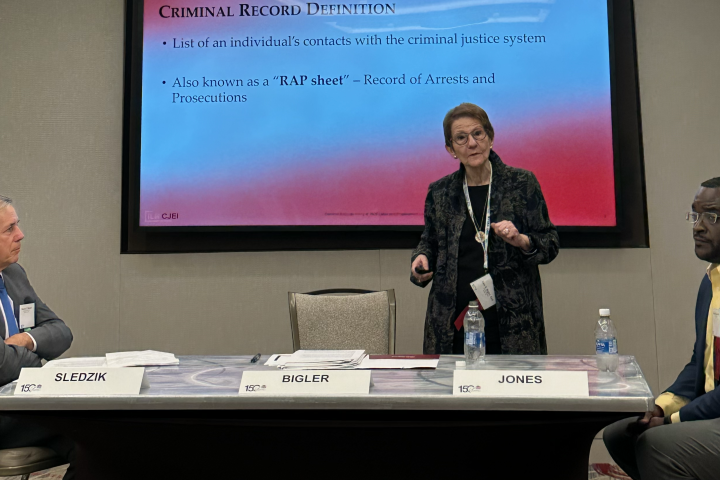
Esta Bigler, director, Labor and Employment Law Program, co-chair of the Cannabis Workforce Initiative, and director, Criminal Justice Employment Initiative. esta_bigler_ilr-lel@cornell.edu
As a part of Cornell ILR’s Labor and Employment Law Program, the Criminal Justice and Employment Initiative (CJEI) works to unlock employment opportunities for the over 2 million justice-impacted people in New York state.
Conviction Records
- 76% have a misdemeanor as their most serious offense.
- 53% have only one conviction.
- 49% have no new conviction in more than two decades.
Collateral Consequences
- 75% are still unemployed a year after being released.
- 40% are five times more likely to make a lower income.
Clean Slate Law
- Notify individuals that their record was sealed.
- Establish a sealing status portal for individuals with the ability to remove errors.
Ban the Box Law
Fair chance hiring delays criminal history inquiries, allowing employers to assess candidates based on qualifications rather than bias. This approach reduces automatic exclusion, supports individualized review in compliance with New York state law, and expands fair access to employment for justice-impacted individuals while increasing the labor pool for employers.
Recommendations
- Enact a New York State Fair Chance Hiring law covering all employees, including temps (except law enforcement), with inquiries after a conditional offer of employment.
- Allow denial of offers only if convictions are job-related or pose a risk.
- Enforcement by the New York State Division of Human Rights.
Visit the Criminal Record Online Toolkit.
IMMIGRANTS AND PRECARIOUS WORKERS
Patricia Campos-Medina, executive director, Worker Institute. pec1@cornell.edu
The Precarious Work Initiative at the Worker Institute focuses on the labor rights and socioeconomic conditions of low-wage and contingent workers who receive little or no benefits and have limited institutional or legal protections. State power shapes low-wage worker precarity via under-regulated workers’ rights, immigration policies and enforcement, and under-addressed legacies of racism and colonialism. Since President Reagan signed the Immigration Reform and Control Act in 1986, the workplace has become a site for immigration enforcement. New York has at-will employment, so even naturalized citizens state that they are under-reporting wage theft and unsafe working conditions.
Key Immigration Policies Driving Obstacles
- The workplace serves as a central site for immigration enforcement.
- Immigration enforcement has been increasingly criminalized.
- Immigrants sometimes feel “rightless” in the workplace.
- The Employment Authorization Document (EAD) process for temporary workers is unpredictable and slow.
Immigration Policy Obstacles to Challenging Precarity
- Puts at-will employment insecurity on hyperdrive – fear of immigration consequences, fear of termination from employment, feelings of ‘loyalty.’
- Further confuses workers about their rights in the workplace and how to access justice.
- Fosters worker isolation and division among workers.
Immigration Policy and Opportunities to Challenge Precarity
- Shared experience of immigration status can unify and build solidarity.
- Immigrant advocacy and organizations can mobilize workers.
- Improved immigration status can embolden workers to step forward.
Recommendations
- Remove immigration enforcement from the workplace.
- Improve the Employment Authorization Document process.
- Decriminalize immigration policy and enforcement.
- Support immigrant worker organizations.
- Provide more pathways to status, including a pathway to citizenship.
Read more about precarious workers in New York state: The Impact of Prevailing Wage in NYS Construction Industry, The Diminishing NYS Mental Healthcare Public Sector, On-Demand Platform Workers Denied Basic Rights, The Role and Value of Labor and Social Protections.
Read more about immigrant workers, specifically, in New York state: Evaluating the Reform and Implementation of NYC Street Vending Laws on Workers, Poor Working Conditions for Nail Salon Workers in NYS, Unprotected App-Based Food Courier Workers in NYC and The Role of Training in Empowering Domestic Workers in NYS.
THE FUTURE OF CARE WORK
Zoe West, senior researcher of worker rights and equity, Worker Institute. z.west@cornell.edu
The Worker Institute’s Future of Care Work Initiative explores the widely devalued, underpaid, and too often difficult and degrading working conditions of care economy jobs. The Future of Care Work advances the needs, voices and experiences of care workers themselves, identifying long-term solutions that value their labor with good wages and dignified working conditions. We do this through training, convenings and research.
Key Statistics about Caregiving in New York
- One in three New Yorkers report that they have unpaid caregiving responsibilities.
- More than 26% of all caregiving respondents said their caregiving responsibilities made it difficult to maintain a job.
- Hispanic and Black respondents – women in particular – reported this at higher rates (47% and 37% respectively).
- Unpaid caregiving made it difficult for respondents to maintain a job across all forms of caregiving:
- 30.4% caring for both children and adult family members.
- 28% caring only for an adult family member.
- 25.6% caring only for children.
- 21.7% caring for friends and/or neighbors.
Among those who reduced their paid work due to unpaid caregiving, the top reason was that care was not affordable – especially true for those caring for children.
Considerations for New York
- Home care, including the Consumer Directed Personal Assistance Program, is a vital part of New York’s health care system and infrastructure that families depend on.
- Efforts to cut costs and size rely on pushing more unpaid caregiving onto already strained families.
- There is evidence of wage theft and other labor violations.
- The challenges of upholding and enforcing labor protections are amplified when work takes place in private homes.
Read more about Home Care in New York State, Improving the Working Conditions of Nannies through Peer Education, Regenerative Organizing Training for Care Workers and Unpaid Caregiving and Its Impact on New Yorkers’ Paid Employment.
CHILD CARE MODELS
Cathy Creighton, director, ILR Buffalo Co-Lab. cathycreighton@cornell.edu
Michelle Artibee, Director of Cornell’s Workforce Wellbeing. mla64@cornell.edu
Child care is fragmented and lacks a centralized mechanism to deliver and oversee all available child care programming. Parents pay for child care using pre- or post-tax dollars, or personal funds for their kids in centers, home care, or in their own home (between $14,700 and $24,000 per year for infant care).
New York state helps with the cost of child care in two ways:
- Eligible for child care subsidy if below 85% of the area median income, 76% of households with a child living at home are now eligible.
- Universal Pre-K programs (not means-tested and not universal, often subject to a lottery).
Key Percentages Relating to Child Care
- 42% of adults with children who decided to forgo employment outside of the home said it was due to child care needs (Empire State Poll, 2023).
- 79% of New Yorkers would support universal child care as a free public service (ESP, 2023).
Policy Recommendations
- Phase out means-tested child care.
- Move towards universal Pre-K for children ages 2-4 years.
- Improve paid family leave.
- Follow the data to understand success.
Success Story
- In Oct. 2023, Cornell announced a $1.86 million (over five years) investment to grow the child care supply in Tompkins County: Providers received business coaching and support from a Child Care Development Director, managed by the Child Development Council of Tompkins County.
- In Year 1, 10 programs were funded, which will lead to an additional 347 spots.
- In Year 2, six providers were funded, leading to 76 additional spots.
Read the Status of Child Care in NYS in 2024 report and Cornell Child Care Initiative Nearly Quadruples Its First-Year Goal.
THE CURRENT STATE OF CLIMATE AND CLEAN ENERGY
Lara Skinner, executive director, Climate Jobs Institute. lrs95@cornell.edu
In 2025, state and federal governments made several monumental decisions affecting the climate and clean energy landscape. Federal actions have led to decreased job creation projections in energy and manufacturing, and New York has seen job creation in these areas slow. However, there are still some bright spots when it comes to the future of work in these areas.
New York Falling Further Behind on Its Climate and Energy Goals
- In January 2025, the state was on pace to reach 53% renewable electricity by 2030. New York is now only on pace to reach 45%. The binding Climate Leadership and Community Protection Act goal is set at 70%.
- Proceeding apace to meet the distributed solar goal.
- Behind on our energy storage goal and our offshore wind goal.
- Likely to have met the building energy savings goal in mid-2025, but the most recent data is not yet available to confirm.
- Not on pace to meet the 40% emissions reduction by 2030 goal.
Clean Energy-Related Developments in 2025
- State energy plan adopted.
- Mixed executive actions on climate.
- Nuclear power back in the spotlight.
- Successful rollout of congestion pricing.
- Slowing job growth in clean energy.
Federal developments continue to impact the state’s clean energy goals, including: One, Big, Beautiful Bill and subsetting of clean energy tax credits; continued attacks and uncertainty on offshore wind; fossil fuel expansion and increase in emissions nationwide; federal budget cuts and threats to democratic states. These lead to national trends, including rising electricity demand, data center expansion, political support with growing backlash, and affordability of clean energy as a salient political issue.
Opportunities
- Thermal Energy Networks – Continue to track the development of utility-led pilots, Decarbonization Leadership Program projects, Sustainable Future Program, and Cap-&-Invest Implementation.
- Labor Standards and Battery Storage – Adding labor standards could help create high-quality union jobs, and bringing permitting under the Office of Renewable Energy Siting and Electric Transmission could help expedite projects:
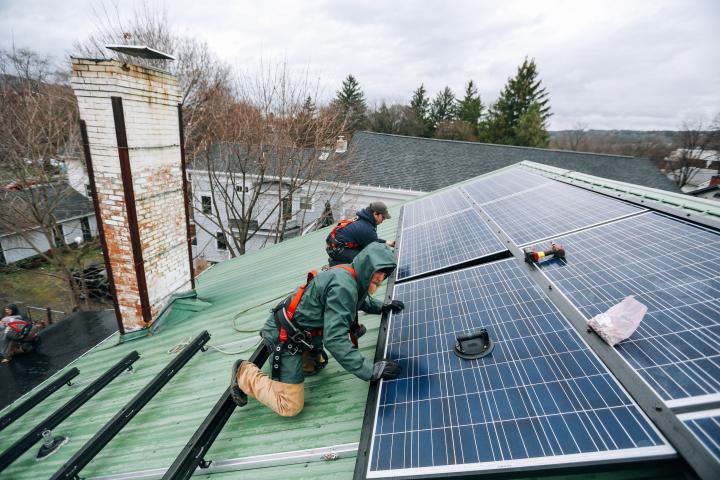
- Solar created most jobs in New York, while Battery Storage is growing.
- New York Clean Energy projects would generate over 11,000 direct jobs from planned and under-construction renewable energy projects.
- Mass Timber – Investment into the industry could reduce construction costs, lower embodied carbon emissions and support union job creation.
- Housing – Continues to be a priority. Gov. Hochul’s “Let Them Build” agenda offers new measures to streamline and enable more housing production.
Read the 2025 New York State Program Climate Jobs Impact Report or enroll in the Clean Energy Economy Online Certificate.