Depoliticizing Language Improves Attitudes Toward Diversity Training
Latest ILR School Research
Executive Summary
Workplace diversity training has become entangled with political debates over diversity, equity, and inclusion (DEI), and Republican employees report increasingly negative views of workplace initiatives. This research asks whether part of that resistance is triggered by the words used to introduce training, rather than by its content alone. Across three experiments and two supplemental studies (total N = 3,209 employed Democrats and Republicans), replacing common DEI terms (e.g., “diversity”) with carefully matched alternatives (e.g., “differences”) increased Republicans’ interest in and enthusiasm for diversity training, both before and after completing it. The effect worked largely because Republicans perceived the reframed training as less politically biased. Reframing did not change what Republicans expected the training to accomplish, and it did not generally lower enthusiasm among most Democrats.
Authors: Devon Proudfoot, Associate Professor of Organizational Behavior, and Sean Fath, Assistant Professor of Organizational Behavior, Cornell University ILR School.
Why Language Matters
Prior research attributes conservatives’ resistance to diversity training to its content: opposition to policies that reduce inequality and a preference for the status quo. The authors add a second explanation drawn from research on affective polarization: people often support what their political in-group favors and oppose what the out-group favors. Terms such as “diversity,” “inclusion,” and “belonging” are not inherently political, but frequent use in partisan debate has given them political connotations. Training introduced with this vocabulary may therefore call to mind political identities and party positions, leading Republicans to read the training as pushing a progressive agenda instead of improving workplace dynamics.
What the Researchers Did
All studies randomly assigned employed Democrats and Republicans to see training framed in common DEI language or in alternative language of similar meaning, adapted from Harvard University’s Glossary of Diversity, Inclusion and Belonging Terms. A pretest confirmed that both groups found the terms familiar, ruling out jargon as an explanation. Study 1 framing examples:
| Common DEI language | Matched alternative language |
| “How to manage employee diversity” | “How to manage employee differences” |
| “enhance employees’ sense of inclusion” | “enhance employees’ sense of being visible, heard, and considered” |
| “foster employees’ sense of belonging” | “foster employees’ sense of being treated like a full member” |
| “promote equity… no one’s outcomes driven by privilege” | “remove barriers… no one’s outcomes driven by unfair advantages” |
- Pilot study (N = 389): Participants chose between reading a workplace-diversity article and seeing other options.
- Study 1 (N = 598) and supplemental Studies S1 and S2: Participants imagined receiving an email about voluntary training and rated their enthusiasm and its expected political bias.
- Study 2 (N = 1,193): The framing was varied, but everyone then completed the same 5-minute training module on ingroup bias, and enthusiasm was measured afterward.
Results at a Glance
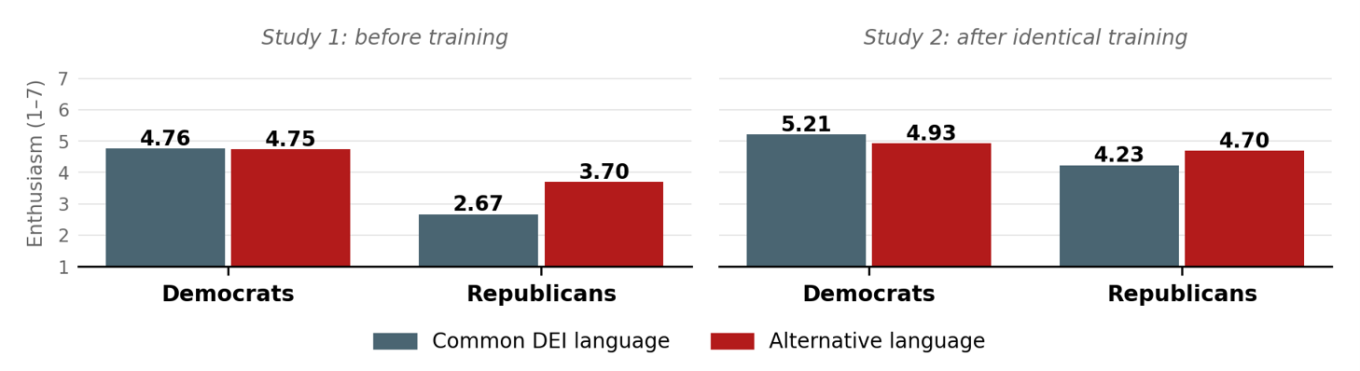
Figure. Average training enthusiasm (1–7 scale) by political affiliation and framing language. Republicans’ enthusiasm rose under alternative language in both studies; Democrats’ did not rise (flat in Study 1, slightly lower in Study 2). Source: Proudfoot & Fath (2026), Studies 1 and 2.
Key Findings
- More Republicans opted in. When the article title used “differences,” 60.0% of Republicans chose to read it, versus 38.7% when it used “diversity.” Democrats showed no difference (about 53–54% either way).
- Republicans were more enthusiastic before training. In Study 1, Republicans rated the alternatively framed training higher (3.70 vs. 2.67 on a 7-point scale). Studies S1 and S2 replicated this pattern.
- The benefit persisted after real training. With identical content, Republicans still reported higher post-training enthusiasm under alternative framing (4.70 vs. 4.23), a smaller but reliable effect.
- Perceived political bias is a key reason. Republicans expected alternatively framed training to be less politically motivated, which partly explained their higher enthusiasm in Studies 1 and 2.
Ruling Out Other Explanations
- Not a signal that race and gender were dropped. Most participants in both conditions expected race and gender content, and results held when controlling for this.
- Not lower expectations of the training’s goals. Two post-tests with Republicans (N = 191 and 185) found that framing did not change perceived goals such as reducing prejudice or improving intergroup interactions.
- Not driven by confusing language or specific words. Understandability did not differ by condition, and the effect was not tied to any single DEI term.
- No harm for Black employees. In a separate sample of employed Black participants (N = 399), alternative framing did not change training enthusiasm, felt belonging, or felt inclusion.
Implications for Organizations
| Takeaway: Part of Republicans’ resistance to diversity training appears to come from the political associations of the vocabulary used to introduce it. Framing training in plain, matched alternative language may be a low-cost way to build buy-in, especially for voluntary training, where initial enthusiasm determines who shows up. |