
Can a Voice Channel Reduce Turnover?
Evidence From a Cluster-Randomized Trial in United States Fulfillment Centers
Purpose
This study examines whether introducing a formal employee voice channel—without unions or additional complementary HR systems—can independently reduce employee turnover. It addresses a long-standing question in organizational research: does giving workers a structured way to share input meaningfully improve retention, and if so, how?
Research Design
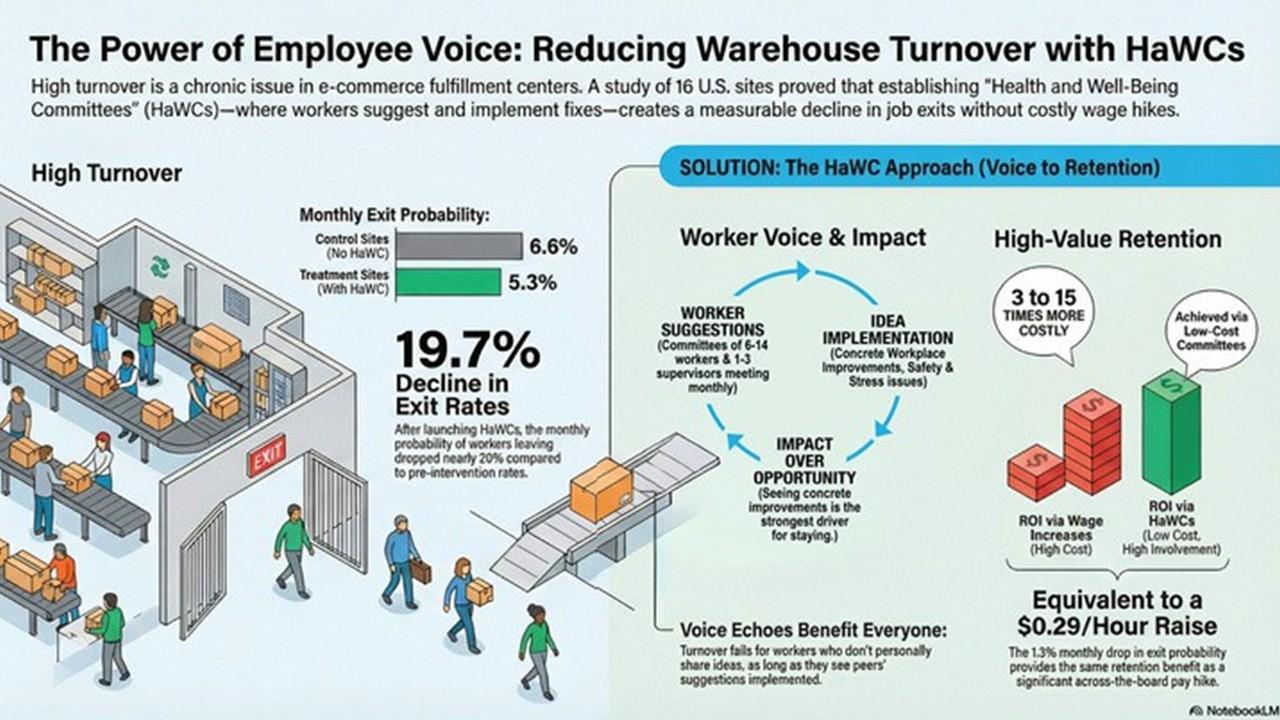
The authors conducted a cluster-randomized trial across 16 United States (U.S.) fulfillment centers (over 8,000 workers) at a large e-commerce firm (“Sigma”). This study represents an industry where turnover is around 40-50% annually and can exceed 100% among new hires. Sites were randomly assigned to either implement a new voice channel — Health and Well-Being Committees (HaWCs) — or continue business as usual. The intervention lasted 12 months, with turnover tracked before and after implementation.
Authors: Alexander M. Kowalski, HR Studies Assistant Professor, ILR School, Cornell University; Erin Kelly, Massachusetts Institute of Technology (MIT), School of Management; Hazhir Rahmandad, Massachusetts Institute of Technology (MIT), Sloan School of Management; and Kirsten F. Siebach, Johns Hopkins University, Bloomberg School of Public Health
Read the Full Paper Here
The Intervention (HaWCs)
HaWCs were small groups of frontline workers and supervisors who:
- Collected concerns and suggestions from their coworkers
- Prioritized which concerns or suggestions to address (e.g., safety, workflow, stressors)
- Designed and implemented improvement projects targeting the priorities
Importantly, this was a standalone voice channel—not bundled with higher pay, training, or other “high-involvement” practices—allowing researchers to isolate the effect of voice itself.
Key Findings
- Turnover decreased significantly in treatment sites.
- The probability of an employee exiting in a given month fell by 1.3 percentage points, a ~20% reduction relative to baseline.
- This effect is comparable to the impact of a modest wage increase (~$0.29/hour), suggesting voice is a cost-effective retention tool.
- Greater impact occurred in sites where:
- More employee ideas were generated
- More improvement projects were completed
- Workers perceived that changes resulted from the committees
Practical Applications
- Organizations can reduce turnover through low-cost, participatory voice systems.
- Impact depends not just on offering voice, but on acting on it visibly.
- Voice mechanisms may be especially valuable in high-stress, frontline environments where traditional retention levers are costly or limited.
Bottom Line
A well-designed employee voice channel—focused on gathering input and driving visible improvements—can significantly reduce turnover on its own. The effectiveness of voice lies in both what employees can say and what organizations do with it.