
From Directive to Shared Leadership
The Context of Virtual Teams
Executive Summary
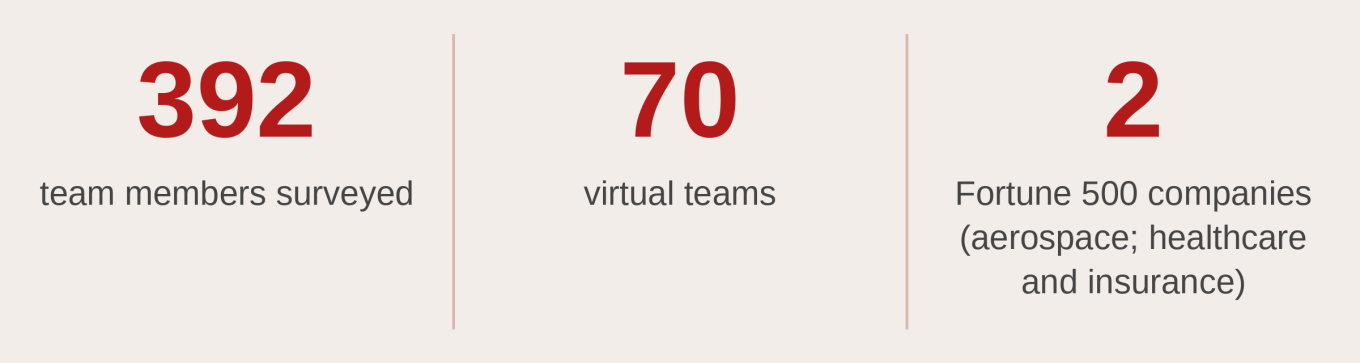
Shared leadership, in which influence is spread across team members rather than held by one formal leader, benefits virtual teams, but it does not emerge easily when members are dispersed and communicate through technology. This field study of 392 members of 70 virtual teams in two Fortune 500 companies found that directive leadership, meaning leader behavior that sets goals, clarifies roles, and establishes routines, was associated with more shared leadership, largely because it built team empowerment. The pathway was somewhat stronger for teams spread across many locations and for teams that rated their communication channels as less rich. The results suggest that structure from leaders can help virtual teams lead themselves, provided it does not turn into control.
Authors: Thao P. H. Nguyen, College of Business and Management, Vin University, Hanoi, Vietnam; and Brad Bell, CAHRS Academic Director and William J. Conaty Professor of Strategic Human Resources, ILR School, Cornell University
The Leadership Tension in Virtual Teams
Virtual team leaders face a dilemma. Shared leadership needs a structural support system of aligned goals, coordinated task strategies, and clear role expectations, yet distance and technology-mediated communication make those conditions hard for members to build on their own. A hands-off leader risks leaving the structure underdeveloped. A hands-on leader risks undermining the delegation that shared leadership depends on.
Building on Bell and Kozlowski’s (2002) framework, the authors argue that directive leadership resolves this tension when it targets the structure of the team’s work rather than monitoring individual behavior. Clear goals and priorities raise members’ sense of meaningfulness and impact; rules and routines that reduce ambiguity build collective competence; and leaving the “how” to the team preserves autonomy. Together these build team empowerment.
Two features of virtuality may determine how much teams need this help:
- Location diversity (how widely members are spread across sites) can split teams into subgroups with competing interests and fragment shared goals.
- Perceived media richness (how well members feel their channels convey cues, feedback, and nuance) shapes their ability to coordinate and build mutual awareness.
What the Researchers Did
Members of 37 aerospace teams and 33 healthcare and insurance teams
(average team size 9.6) completed online surveys at two points five weeks apart. The first survey measured directive leadership, location diversity, and perceived media richness; the second measured team empowerment and shared leadership, which helped reduce common-method bias.
Key Findings
- Directive leadership went with more shared leadership. Teams whose leaders set goals, clarified expectations, and structured work reported more shared leadership (b = 0.98).
- Team empowerment was the mechanism. Part of the link ran through empowerment
(indirect effect = 0.37). - Location diversity strengthened the pathway. The indirect effect was larger for highly dispersed teams (0.38) than for teams at fewer sites (0.23).
- Lower perceived media richness strengthened it, modestly. The indirect effect was larger when teams rated channels as less rich (0.27 vs. 0.22), a smaller gap.
Results at a Glance
How directive leadership leads to shared leadership, and when it matters most
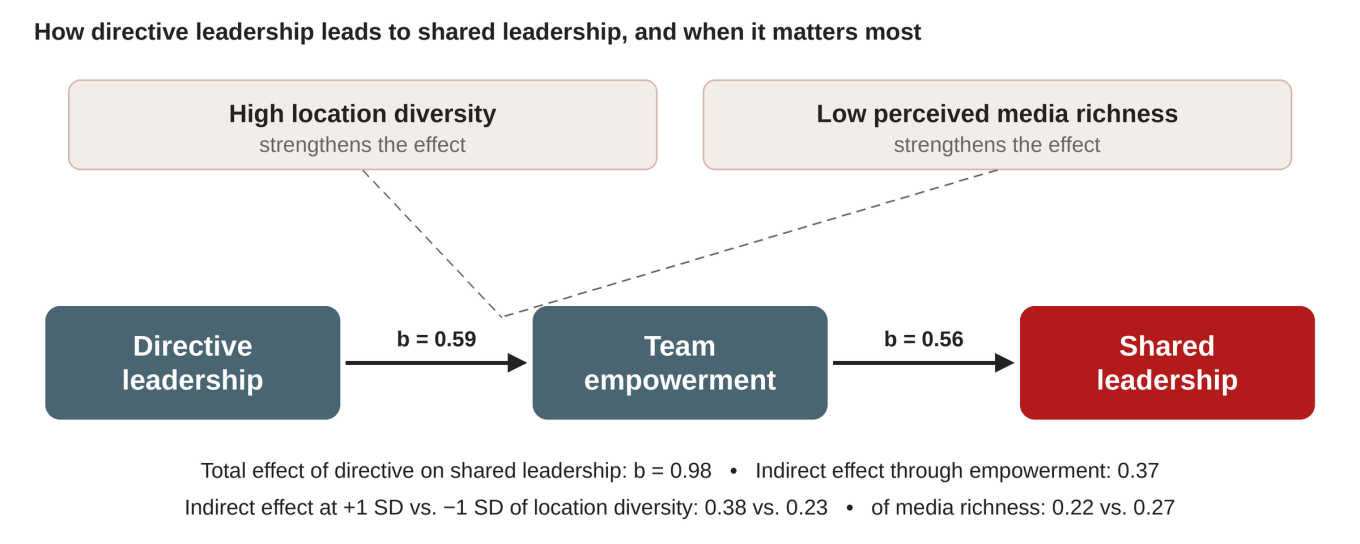
Total effect of directive on shared leadership: b = 0.98 • Indirect effect through empowerment: 0.37 Indirect effect at +1 SD vs. -1 SD of location diversity: 0.38 vs. 0.23 • of media richness: 0.22 vs. 0.27
Figure. Conceptual model with estimates from the study (N = 70 teams).
b values are unstandardized regression coefficients. Indirect effects are shown at one standard deviation above and below the mean of each moderator.
Implications for Organizations

- Build structure, not control. Leaders should articulate goals, define roles, and set routines. Watch for drift: continuing to specify goals and workflows after a team has internalized them, or members deferring decisions within their own scope, can signal that direction has become micromanagement.
- Tailor direction to the team’s context. Expect to provide more structure for highly dispersed teams or those with low perceived media richness, and shift toward sustaining empowerment as teams develop their own routines.
- Track empowerment and perceived richness. Brief pulse surveys of meaning, competence, autonomy, and impact, alongside perceptions of communication channels, can catch problems early. Training on tool use and clearer communication norms can raise how rich teams find their channels.
Limitations and Open Questions
- Team empowerment and shared leadership were measured at the same time, and most measures were self-reported, so common-method bias cannot be fully ruled out. The media richness interaction is less vulnerable to this concern.
- The sample covers two organizations in different industries, and shared leadership was lower in the healthcare and insurance company, so results may not generalize across industries or functions.
- Future work should compare directive leadership with relational styles (such as servant leadership) and test other virtuality dimensions, such as time-zone spread.