Collective Representation as a Response to Worker Precarity in the Green Jobs Economy
Collective Representation as a Response to Worker Precarity in the Green Jobs Economy, hosted by ILR School’s Worker Institute in partnership with the Climate Jobs Institute, highlighted the need for community-driven approaches in developing high-quality green energy jobs and infrastructure. Moderated by the Worker Institute’s Research Director for Worker Rights and Equity Anne Marie Brady, participating experts included the Climate Jobs Institute’s Reyna Cohen, Research and Policy Development Associate, and Melissa Shetler, Assistant Director of Labor Outreach and Workforce Equity, Maine Labor Climate Council Director Francis Eanes, Jobs to Move America Southern Program Director Will Tucker, and Workshop Senior Advisor Doug Bloch. The virtual event, hosted on June 24, set the stage for the subsequent discussions on collective responses to worker precarity, which will be held later this year.
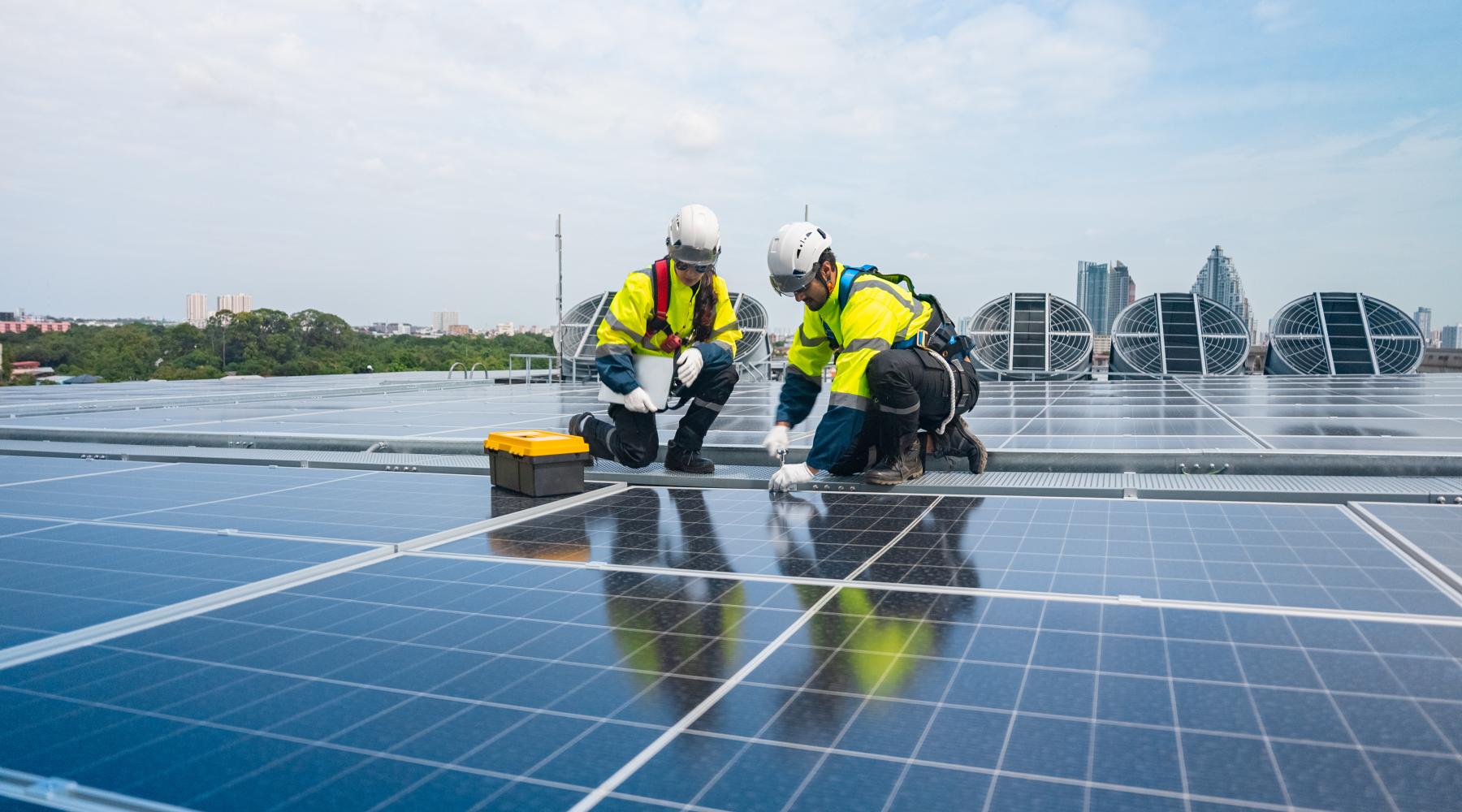
Reyna Cohen started off the webinar by laying the foundation for the event by sharing the specific forms of precarity endured by solar and wind energy construction workers in New York and Texas, who experience unstable employment, rampant wage theft, and piece-meal pay rates. The impacts of climate change make this work all the more dangerous, heightening precarity for workers who often lack access to breaks or workers’ compensation in the event of an on-the-job injury. In both states, workers experience disparate treatment based on race and gender, which impacts their wage-level, access to benefits, and employment tenure. Within the electric vehicle manufacturing sector, Cohen detailed the precarity faced by workers, who fear retaliation from their employers for taking time off, and often experience pay gaps based on their employment status. It’s these experiences which emphasize the need to focus on collective pathways to just transition, and laid the basis for why it is so important to address worker precarity in the clean energy economy.
The featured presentations from Francis Eanes and Will Tucker pinpointed the nuanced strategies necessary to build expansive, community-centered coalitions, which provide win-win solutions for workers and their neighbors. In both Maine and Alabama, organizing initiatives resulted in concrete financial gains for residents, leading to greater equity and security for the working-class communities, as well as more union jobs in the green energy sector.
At the Maine Labor Climate Council (MLCC), Eanes and his team linked the needs of mobile home residents with decarbonization goals to foster a robust coalition between end-users and workers, leading to heightened security and financial prosperity for entire communities. As cost-of-living skyrockets for families across the country, the lot rent for mobile home residents in Maine continuously increases as private equity swallows up the land to extract further profit from renters. In the face of this affordability crisis, the MLCC set out to organize thousands of mobile home tenants. Through this campaign, tenants have been able to secure rent-stabilizing ordinances and in some cases cooperatively buy the land their mobile homes sit on. This community-centric organizing effort is a step toward prioritizing access to weatherization and heat pump installation for these communities, aggregating what would otherwise be piecemeal residential construction to instead help grow high-quality union jobs in building decarbonization. The MLCC’s campaign would not be possible without the support of the mobile home residents, showing that engaging with end-users to drive the development of quality green jobs in the residential construction sector is a crucial component of scaling up green energy projects. As Eanes later discussed, this kind of long-term endeavor requires the simultaneous organization of the end-users, developers, contractors, and workers to develop holistic solutions to multi-level problems.
At Jobs to Move America (JMA), Will Tucker and his team’s campaign to secure a detailed and legally binding Community Benefits Agreement (CBA) transformed the New Flyer of America manufacturing facility in Anniston, Alabama, improving working conditions and hiring policies within the largest electric transit bus manufacturer in the country. With the help of the Alabama Coalition for Community Benefits, organizers gained legally enforceable protections for New Flyer workers without relying on the state legislature to pass progressive laws. One of the major feats of the extensive Community Benefits Agreement includes the implementation of hiring goals with a focus on economically disadvantaged communities, and in particular, justice-impacted individuals. Additionally, the CBA enstilled safety requirements and an accountability system for the duration of the agreement. In pursuance of its new hiring goals, New Flyer eliminated its temp-to-hire practice, providing direct-hire, union jobs to Anniston community members thus directly responding to one way precarity manifested itself in the nature of jobs at New Flyer. After ratifying the CBA in 2022, the workers at New Flyer’s Anniston plant ratified a union contract with the company, further bolstering their wages, benefits, and on-the-job training opportunities. Workers at New Flyer facilities in Shepherdsville, Kentucky, and Jamestown, New York also ratified union contracts, covering a total of 1,200 workers.
In the New Flyer case, the needs of the community were directly tied into JMA’s construction of the CBA. Prior to the agreement, groups historically disadvantaged in the labor market were all but shut out of New Flyer employment. The factory in Anniston—a small-city with a majority-Black population—primarily employed white men. Tucker shared the story of one worker named Shannon, who, prior to the Community Benefits Agreement, applied to work at the New Flyer facility repeatedly but was never hired. Shortly after the agreement was ratified, she was hired at the plant, and went on to take on a leadership role in the union. By focusing on how the hiring initiatives and workforce development training could improve the socioeconomic outcomes for everyone in Anniston, the CBA then opened the door to unionization, further solidifying these gains. JMA’s next campaigns will target Kawasaki plants in Yonkers, NY and Lincoln, NE, whose workers build rail cars for New York City’s MTA, as well as Hyundai-Kia’s U.S. supply chain. As someone whose work is rooted in the South, Will Tucker underlined the importance of linking producing regions with the progressive, urban purchasing regions throughout the country. It’s often the case that the vehicles and equipment made by the manufacturing workers JMA organizes are bought by large city agencies.
As emphasized throughout the event, one pivotal component of developing high quality union jobs within the green energy sector requires a commitment to pre-apprenticeship and apprenticeship programs. As CJI’s Melissa Shetler explained during the webinar, these forms of equitable job training are crucial in breaking the cycle of exploitation of workers historically excluded from job training opportunities who, as a result, are frequently recruited into low quality, low paying, precarious construction work. In June 2025, the CJI established an education program through P2A, or Pathways to Apprenticeship, which recruits individuals from low-income communities and prepares them for union construction apprenticeships. The Maine Labor Climate Council and Jobs to Move America both center pre-apprenticeship and apprenticeship programs in their campaigns, creating strong ties between community-based environmental organizing and workforce development. As Workshop’s Doug Bloch further explained: Under the Biden administration, government incentives were contingent on recipients establishing community benefit agreements, project labor agreements, and utilizing apprenticeship programs. This model continues today as communities grapple with the expanse of data centers, which pose a new set of challenges for workers and residents alike.
In his discussion, Bloch highlighted the ongoing work of ReImagine Appalachia and Memphis Community Against Pollution (MCAP) as they grapple with the impacts of the Elon Musk-owned xAI supercomputer, Colossus, which has been operational in Memphis’s Frank C. Pidgeon Industrial Park since 2024. Since signing a CBA with the company, xAI has committed to constructing a new water treatment facility, which will resume construction later this year. The city’s newly formed AI Advisory Board on Community Benefits is currently discussing how the 25 percent of the xAI property tax revenue will be invested into the communities surrounding the Colossus data center. The priorities of the board include weatherization assistance, public safety, workforce development and economic opportunity, as well as air quality monitoring and environmental mitigation. Additionally, xAI is now facing litigation after the Southern Environmental Law Center and NAACP filed a lawsuit against the company for violating the Clean Air Act with its use of unpermitted gas turbines to run its data centers.
When discussing the impacts of these campaigns, each participant highlighted the ways in which collective organizing reaped tangible, life-improving benefits. Whether through direct employment, training opportunities, or the bolstering of tenants rights, these projects have been able to provide security for individuals by building power in numbers. The organizers have been successful not only in minimizing precarity and establishing stronger communities, but in expanding an equitable green jobs economy.