


Summer at Scheinman: Six Students, Six Paths Into Labor and the Law
Every summer, students connected to the Scheinman Institute scatter across the country, into archives and case files, into courtrooms and government offices, into communities navigating housing crises and workplace disputes. This year, six of them agreed to share what their summers actually looked like: two undergraduate researchers coding arbitration decisions from the pandemic, two students who spent their summers in New York City through the High Road Fellows Program, and two who found their own way into government and law firm internships. Together, their experiences trace the range of what a Scheinman connection can lead to.
Research: Reading Arbitration Through a Pandemic
When Harlan Phillips Flamm,‘29, walked into his Intro to ILR class and heard Marty Scheinman speak, he didn't think much of it. It wasn't until he wandered into Ives Hall, discovered the Scheinman Institute, and joined the Conflict Resolution Club that things clicked. That path led him to Professor Dionne Pohler's Intro to Conflict Resolution and Negotiation class, then to her office hours, and eventually to a research assistantship.
This summer, Harlan and fellow undergraduate researcher Laila Nicole Larkin, ‘29, spent their time coding arbitration verdicts from COVID-era labor disputes involving vaccine mandates, workplace safety complaints, sick leave disputes and termination cases for a project on how arbitrators reason when established legal doctrine doesn't clearly apply.
"The core question was how arbitrators reason when the normal legal framework doesn't clearly cover the situation in front of them," Harlan explained. "Arbitration relies heavily on precedent and established doctrine, but a genuinely novel, high-uncertainty event forces arbitrators to improvise." COVID, he said, created a natural experiment: a sudden wave of cases where existing rules didn't map cleanly onto the facts, forcing arbitrators to actively construct their reasoning rather than simply apply settled rules.
Day to day, that meant reading case after case, and coding for recurring legal concepts such as just cause, informed consent coercion, and tracking how each one was invoked, reinterpreted or stretched to fit a pandemic context. Harlan focused on how those concepts were applied across cases; Laila focused on what arbitrators counted as expert evidence, and how they weighed different kinds of testimony and documentation. "We compared notes regularly so our two threads fed into a shared picture of how arbitrators reasoned under uncertainty," he said.
While the full findings remain confidential, Harlan pointed to one pattern that stood out: how arbitrators drew the line on what did and didn't count as coercion in situations COVID created that didn't map onto how coercion was traditionally understood.
Laila, whose research took her deeper into how arbitrators evaluated expert testimony, was equally central to the project's findings. The two researchers' threads were designed to run in parallel and inform each other, and Harlan is quick to describe the work as a shared effort rather than two separate projects that happened to overlap.
None of it would have happened without donor funding, he was quick to note. "I was able to get paid for the work. I'm required to be compensated in order to take on a role like this, so without that funding, I wouldn't have been allowed to serve as a research assistant at all." For Harlan, the summer did more than produce data. It confirmed a career direction. "Spending the summer coding arbitration verdicts familiarized me with legal lingo and how legal concepts actually get applied in practice, not just how they're defined in a textbook," he said. "It's made me feel much more prepared for law school."
The scale of the project was daunting at first: hundreds of documents, each one slow going in the early weeks. But as he found his rhythm, the work became manageable and even rewarding. "Knowing that the patterns I was coding hadn't been identified previously made the work feel meaningful," he said. "I felt like I was contributing something new to how people understand arbitration during moments of crisis."
High Road NYC: Housing Stability and Waterfront Oversight
Two of the Scheinman Newsletter student editors spent their summers in New York City through the ILR NYC High Road Fellows Program, working in very different corners of the city's institutions.
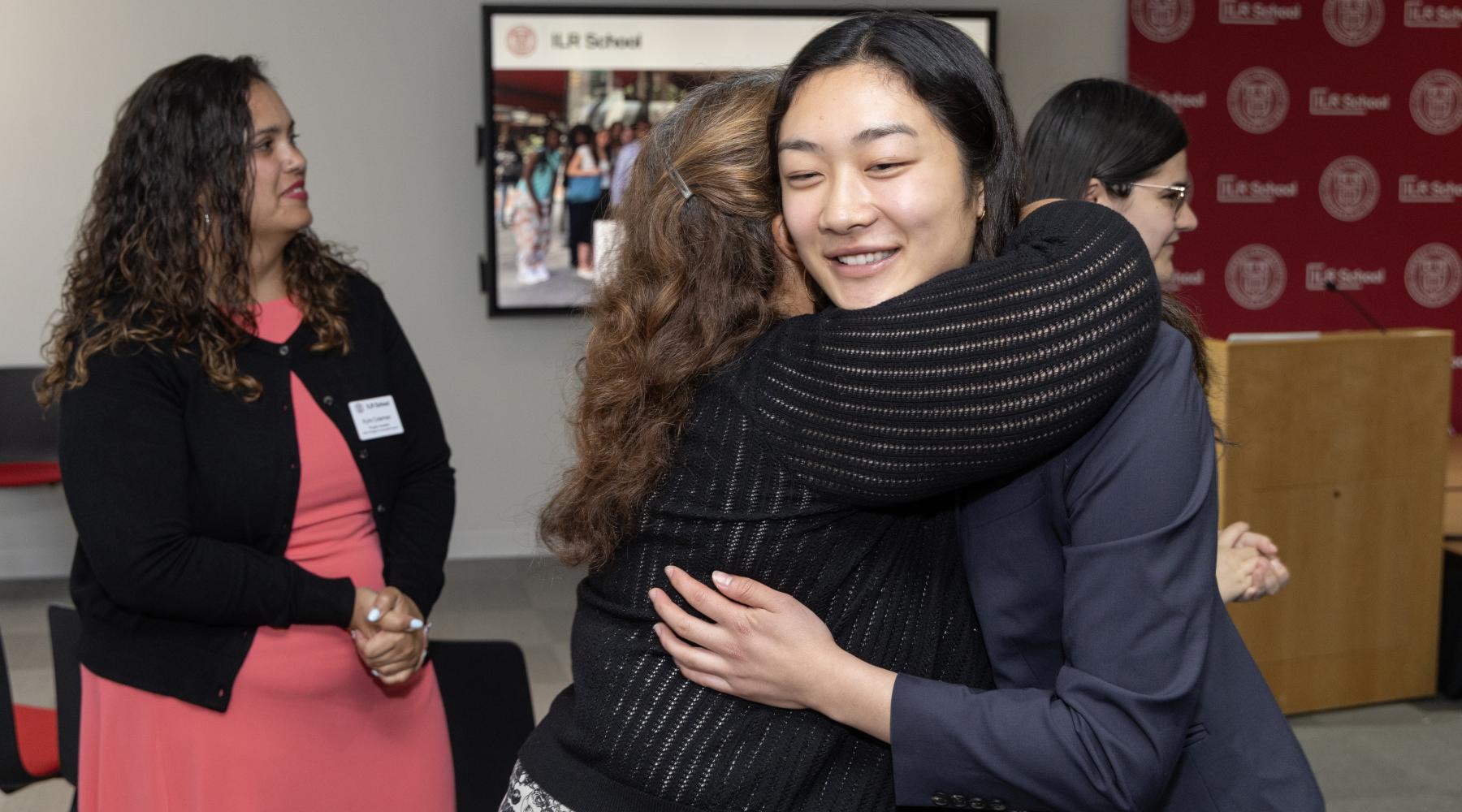
Mackenzie Luk , ‘28, worked with Project Home, a team within University Settlement, a settlement house focused on fighting poverty and inequality through a range of social services. Project Home specifically provides eviction prevention and housing stability support, and Mackenzie spent the summer working directly with clients on rental arrears, maintenance and habitability issues and applications for public benefits.
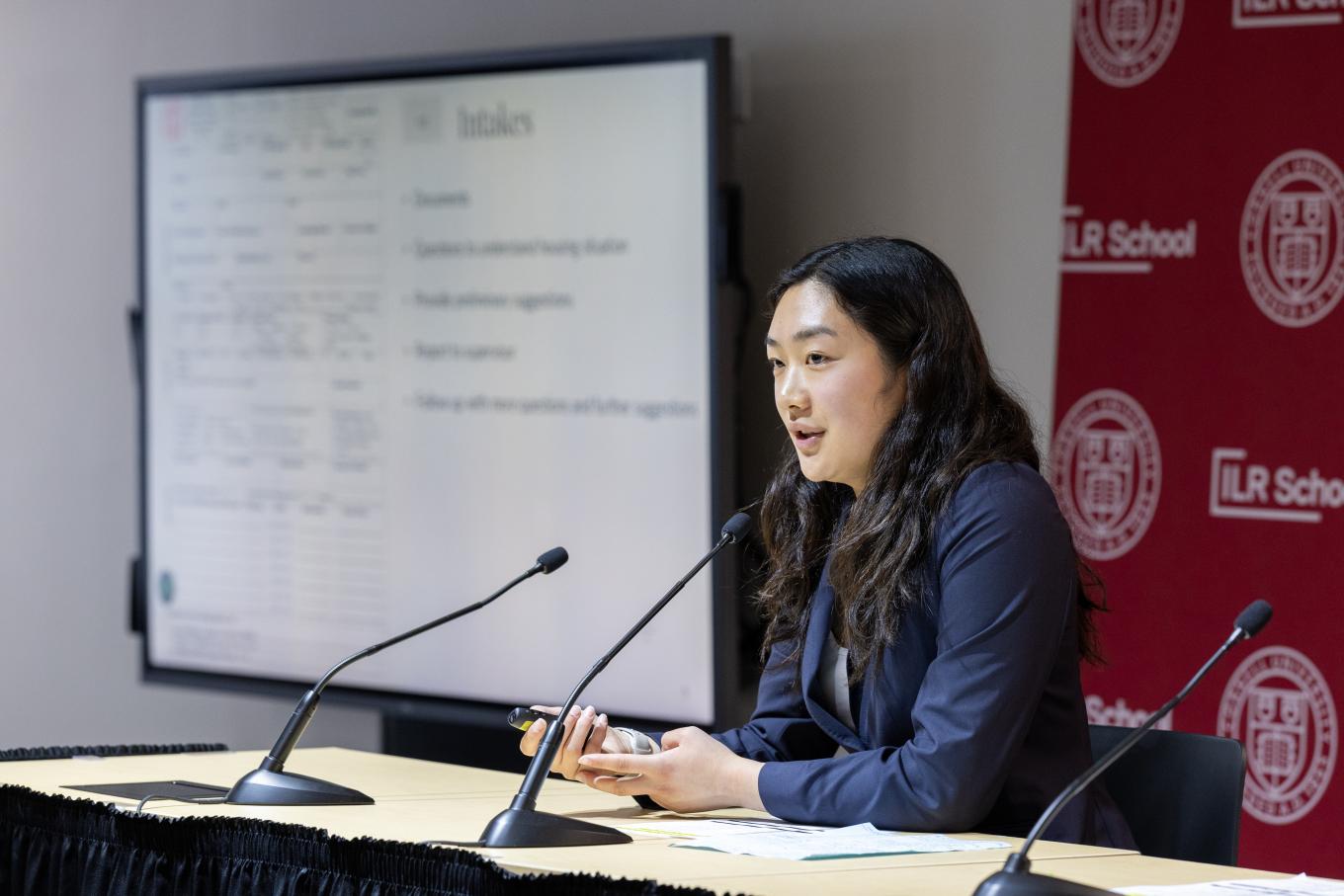
Because she was part of a small team, her role shifted with whatever the team needed that week. "This variety allowed me to gain hands-on experience in several areas, including case management, drafting reports, conducting outreach and preparing policy briefs," she said.
One goal she set for herself going in was to put her Chinese language skills to use. In the final week of the internship, she worked with a colleague to deliver a presentation on rental freezes entirely in Cantonese, a moment she counts among her proudest of the summer. "I was proud of my ability to use my language skills and to connect with clients in a new way," she said.
Outside the office, the High Road program built on its own set of experiences: a trip to Top of the Rock, a meal at Sylvia's in Harlem, and a talk from Randi Weingarten, president of the American Federation of Teachers, on the role of public education in a democracy. For Mackenzie, who isn't from New York, simply living in the city for a summer was part of the experience. "I enjoyed living somewhere that is the center of everything," she said. "From the Knicks' championship run to the World Cup to the sheer number of museums and educational opportunities the city has to offer, New York City was an amazing place to work and live in."
Gabriela Goncalves Vieira, ‘27, also a High Road Fellow and project manager for the Scheinman Conflict Resolution Club, spent her summer with the NY Waterfront Commission, working under supervisor Paul Babchik. The Commission was created by a bi-state compact between New York and New Jersey to police the Port of New York and New Jersey and root out the organized crime, extortion, and labor corruption that had long plagued the docks, the same world of mob-controlled hiring and racketeering immortalized in On the Waterfront. Its mandate is to keep the waterfront's labor practices clean and its workforce free of criminal influence.
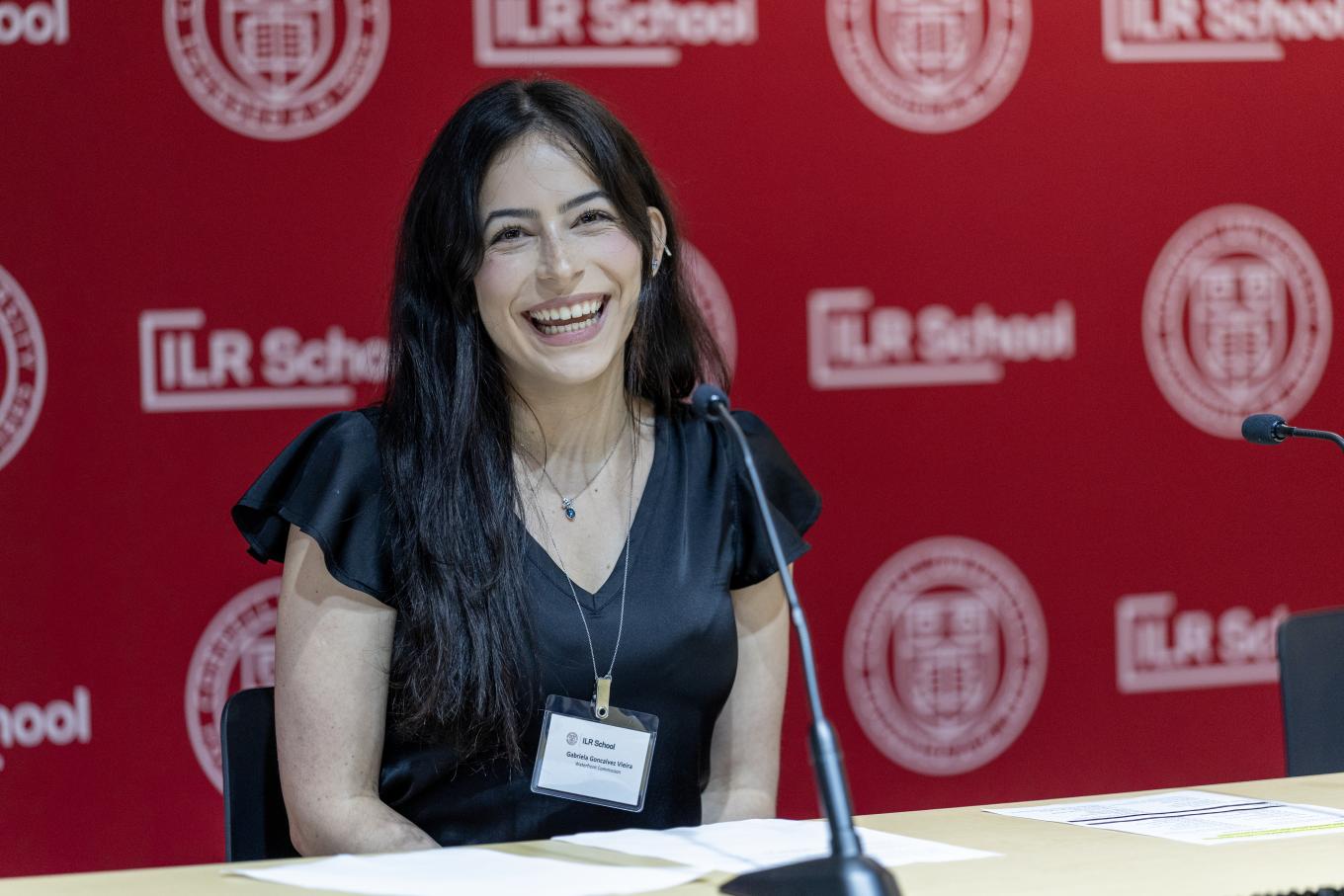
Gabriela was the only college student on a team of six law student interns, which meant her weeks moved fast and rarely looked the same twice. "A typical week consisted of morning debriefs and prep work to tackle the day," she said. "I often circulated between different groups to help on tasks." Every week brought a new round of depositions and interviews with people seeking a license to work on the piers of New York City, followed by debriefs on whether each application had merit and met the standards laid out in the Waterfront Commission Act. Interns also rotated through presentations on different aspects of the Commission's work, reviewed internal memos for their supervisor and conducted research. "As a legal fellow, my work touched almost every part of that process," she said.
One highlight of the summer was a mock trial built around an active case. Gabriela played both witness and defender in the simulation, prepping with a team of law students before facing direct and cross-examination with her supervisor sitting in as judge. "This exercise allowed my boss to see which arguments would best hold up in the administrative hearing," she said. Another similar experience also revealed an unexpected favorite part of the job: discovery. In one case, she spent hours combing through old case files in search of specific names that were relevant to a current application. “Although I can’t give details since this is privileged information, I can assure you reading those hundreds of pages was worth it,” she said.
Outside the office, two moments stood out. The Commission took its interns to a Mets game, Gabriela's first baseball game ever. She said she "had a lot of fun eating hot dogs and enjoying the sun". Later in the summer, with her office on Broadway in the Financial District, she had a front-row view of the Knicks championship parade passing right below her window. She was also excited that she "was able to take great photos of the team.”
Traditional Internships: A Law Firm and a State Auditor's Office
Not every Scheinman-connected student spent the summer through a formal fellowship. Jack Engel and Farrah Zerola each found their own paths into legal and government work.
Jack Engel, ‘28, recruitment chair for the Scheinman Conflict Resolution Club, interned in the investigations department at Labaton Keller Sucharow, a plaintiffs'-side law firm known for securities class actions, antitrust litigation and consumer protection cases. The firm represents investors and consumers harmed by corporate misconduct, often against large corporations, and Jack's job was to help build those cases by researching and gathering evidence to support the attorneys' work.
His days started with a department meeting to go over ongoing cases and priorities, followed by hours of evidentiary research: tracking down former employees who might be relevant to a case, identifying other people with useful knowledge and gathering background information, all while staying in close contact with attorneys about what they needed. "Most of my time was spent on evidentiary research," he said, describing work that was both independent and deeply embedded in a larger team effort.
One project stands out. Jack helped compile a timeline of evidence that directly contradicted public statements made by a company being sued for securities fraud, a timeline that ended up in the complaint the firm filed. "It was a really rewarding moment because it showed how the research I was doing had a direct impact on the case, rather than just being background support work," he said.
He credits two classes with preparing him for the work: Labor and Employment Law with Professor Racabi, which he says taught him how to understand and brief legal documents, and Corporations, Shareholders, and Policy with Professor Geddes, which gave him a grounding in securities law and corporate structure. "I'd highly recommend both classes," he said. "Both professors are fantastic and the material is genuinely interesting."
The internship's biggest challenge wasn't any single task, but its pace. "Unlike undergrad, where work and exams tend to come in large waves, at the internship there was always something challenging to work on," he said. "That said, it wasn't entirely a downside, it meant I was never bored and was constantly learning."
The turning point of Jack's summer came in a courtroom. He attended a real hearing for a case he had worked on, watching arguments against a motion to dismiss filed by the defense. "I was fully engaged and immersed the entire time," he said. "Before this internship, I had been leaning toward law school, but after that hearing, I became fully committed to that path." His advice to students eyeing law school: take undergrad seriously and consistently, go to office hours, attend lectures, don't skip the readings, and start figuring out early what kind of law actually interests you.
Farrah Zerola, ‘29, president of the Scheinman Conflict Resolution Club, took a different route into government work, landing a planning and policy internship at the Massachusetts State Auditor's Office on her own. The office conducts performance and compliance audits across more than 200 Massachusetts government agencies to make sure they're running effectively.
Farrah's days were built around pre-audit research, digging into different agencies, background-checking them or going deeper on areas of particular concern, punctuated by meetings with her division, stakeholders and audit teams. Her work in the planning and policy division was a mix of independent projects and regular check-ins with her supervisor. "My supervisor would let me know of the projects I needed to work on, and then I would check in with her throughout the process to make her aware of my progress," she said.
The job taught her things no classroom could, particularly how to research efficiently in unfamiliar territory and how to present to a much wider range of audiences than she was used to, supervisors, senior deputy auditors, stakeholders and entire audit teams. Her Psychology of Work class, she said, had already given her a leg up navigating the internship application and interview process itself.
What surprised her most was how hands-on the work turned out to be. "I was contributing in real time to audits, I was able to make an impact that was tangible," she said. The hardest part was the opposite problem: projects where the information she needed simply wasn't available or was buried, requiring her to dig for a clearer picture of what was actually happening inside an organization.
Her advice for students curious about government work is to start local. "If you want to work in government, starting out at your local or state government is a great way to get a feel for what this kind of work looks like, and you will likely have real work to do," she said. Beyond the work itself, Farrah said the people made the summer: colleagues, fellow interns, and people she met outside the office who she plans to stay in touch with.
A Common Thread
Six students, six very different summers: a research lab, a housing nonprofit, a waterfront commission, a securities litigation firm and a state auditor's office. But running through all of them is the same throughline: a Scheinman connection that pointed each student toward hands-on work in labor, law and conflict resolution, and, in nearly every case, sharpened their sense of where they want to go next.


