



Overview
The Climate Jobs Institute’s newest report, “Bringing Unions Home: A Blueprint for Labor-Led Residential Decarbonization in New York,” envisions coordinated, worker-centered strategies to help New York decarbonize its private residential market, lower energy bills, create high-quality union jobs, and reduce emissions.
New York is in the throes of a widespread affordability crisis, and housing is at the heart of the issue. From an ever-shrinking pool of an aging housing stock, New Yorkers are often forced to choose between affordability and livability, all while the costs of healthcare, groceries and utility bills continue to rise.
Even for homes that can be upgraded, the residential construction market is rife with low-road labor practices, where workers receive disproportionately lower pay and weaker benefits than their union counterparts and face worker misclassification and wage theft – effectively locking these workers into lower-quality housing themselves with few pathways to improve.
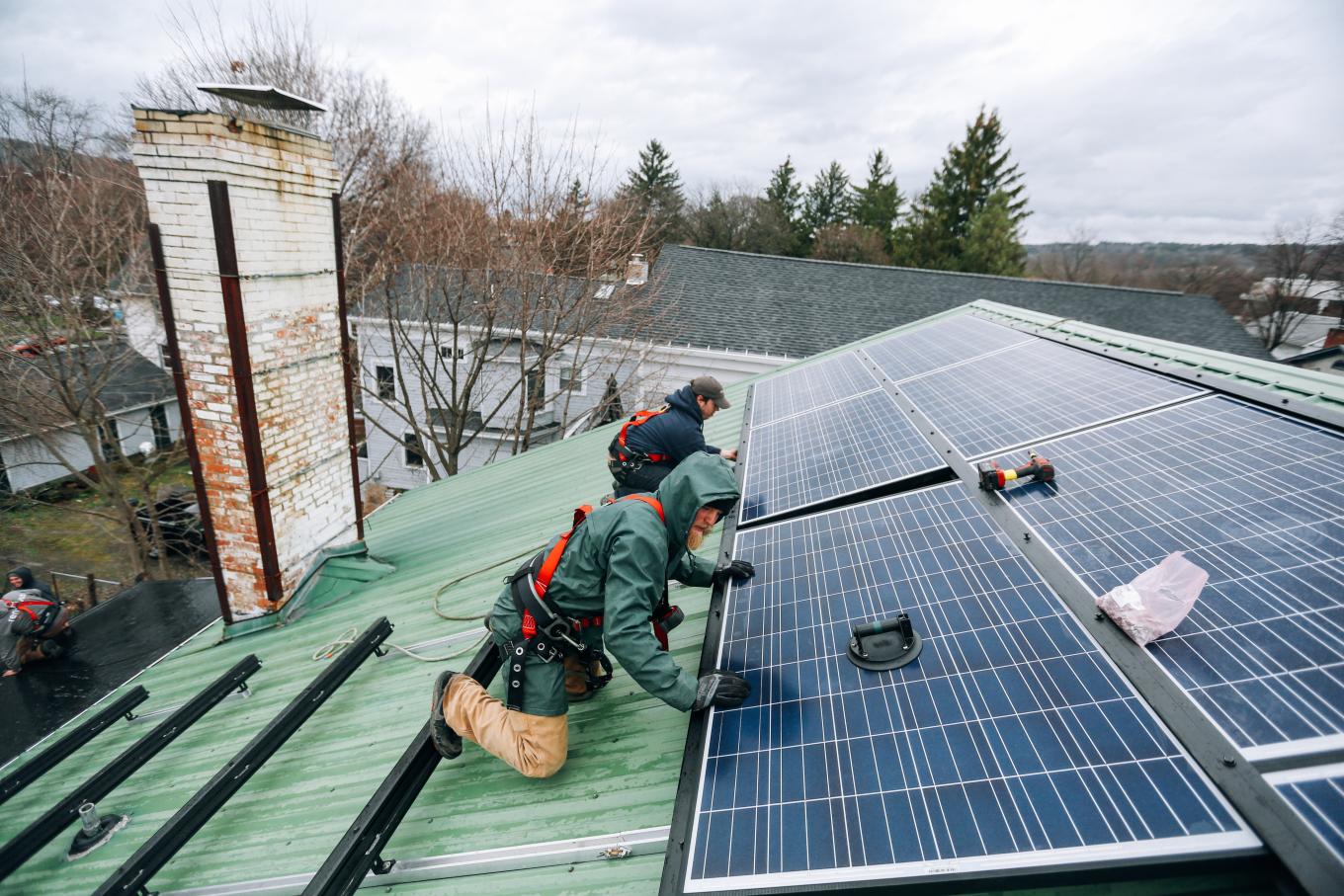
"New York has an opportunity to tackle both the affordability and climate crises by turning to one of its most underutilized resources – homes – and prioritizing union labor. With the right programmatic levers that trigger high-road labor standards and deploy workers to neighborhoods at scale, labor is the linchpin of a statewide housing improvement strategy. We have the tools to repair housing right. Now, it’s time to get organized."
Key Findings
- The average age of existing residential buildings in New York is 65 years old.
- New York has almost 3 million residential buildings, and more than half rely on fossil fuels.
- New York’s current suite of building upgrade programs is insufficient to meet the needs of its aging housing stock.
- The promise of high-quality union construction careers has eroded across the country in the last several decades.
- The state has yet to implement a comprehensive, worker-centered strategy to address the inequities in affordability, deferred maintenance and labor issues in its private housing industry.
Recommendations
By leveraging economies of scale and innovating across various segments of New York’s housing sector, the policy building blocks in the report are designed to meet the dual needs of scaled emissions reduction and energy efficiency by creating good union jobs.
“Bringing Unions Home” recommended policy building blocks:
- Healthy Home Improvement Program (HIP): A “one-stop-shop” offering turnkey retrofit services to customers at little to no upfront cost, implemented at scale by union workers.
- Power Network Infrastructure: Harness the power of homes – and union workers – to provide rapid, coordinated, zero-carbon relief to the grid.
- Buy and Build Better New York (BBBNY): Spur local manufacturing by using high-quality union jobs to deliver bulk best-value procurement of building upgrade components.
Research Impact
New York state is reeling from an inequitable affordability crisis. From electricity to groceries, record-high prices for everyday necessities are putting hardworking families into debt and making it harder to survive. What’s more, New York’s residential construction industry, which is largely non-union, has eroded the promise of a high-quality union construction career over the last several decades and ultimately failed to adequately address the breadth of critical residential needs.
On both decarbonization and affordability, New York is underutilizing one of its most important resources: homes. The state-led and worker-centered policies in this report go beyond New York’s current voluntary and disorganized approach to envision coordinated strategies that can catalyze widespread housing decarbonization and unionize the residential sector. Applied at scale, the policy building blocks can help address the multiple issues propelling New York’s inequitable affordability crisis by lowering bills, reducing emissions and establishing pathways to high-road union careers in the construction industry.
AUTHORS:
Lynda Nguyen, CJI Associate, Reyna Cohen, CJI Research and Policy Development Associate, Nathan Lamm, CJI Senior Research Support Specialist, Grennan Milliken, CJI Associate & Megan Thorsfeldt, CJI Sr. Extension Associate.