Cornell University mobile logo

Upcoming Events

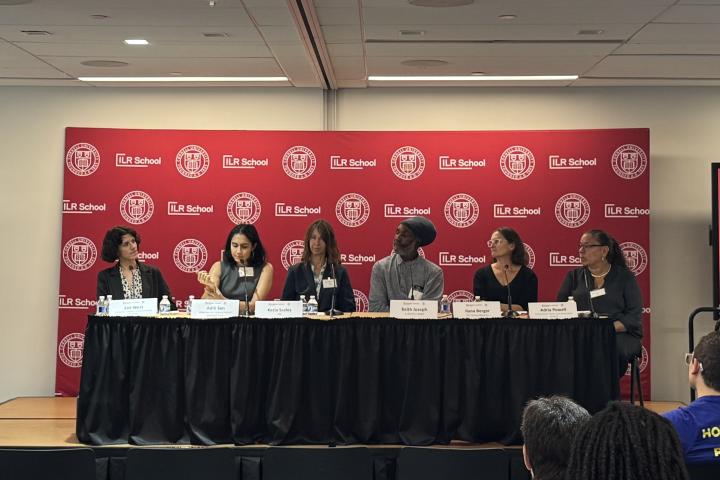
Worker Precarity in Journalism, Academia and Computer Programming

Collective Representation as a Response to Worker Precarity

What do part-time or underemployed workers without health benefits, pensions or job security who work split shifts at a number of different locations each week have in common? They all hold a university degree, often with at least one master’s degree and/or a doctorate, but find themselves in precarious, insecure work.

A man and woman sitting down working together looking at a shared tablet
Worker Precarity in Journalism, Academia and Computer Programming
cornell-seal Icon

About the Institute

The Worker Institute at Cornell engages in research and education on contemporary labor issues, to generate innovative thinking and solutions to problems related to work, economy and society. The institute brings together researchers, educators and students with practitioners in labor, business and policymaking to confront growing economic and social inequalities, in the interests of working people and their families. A core value of the Worker Institute is that collective representation and workers’ rights are vital to a fair economy, robust democracy and just society. Learn more about all of our offerings.

Worker Institute

Core Offerings

The Worker Institute serves as a hub for policy research, publication, and training for policymakers, entrepreneurs, and activists engaged in the public debate to reduce economic inequality.

megaphone

Student Engagement

Student Engagement

The Worker Institute is committed to engaging Cornell ILR undergraduate and graduate students through our courses, research fellowships, graduate programs and other professional development opportunities.


Students on international experience trip
Learn more about our work with students.

In the News

Media Mentions

Poll finds that unpaid caregivers face financial challenges

WBNG
Zoë West, a senior researcher of worker rights and equity at ILR’s Worker Institute, comments on issues raised by the latest Empire State poll about balancing unpaid caretaking and paid work. West contributed to the poll project, which was highlighted in ILR’s 2024-25 New York at Work report.
Poll finds that unpaid caregivers face financial challenges

Cost of living a major concern for New York workforce

Cornell Chronicle
Now in its fifth year, the 2024-25 New York at Work report draws on ILR expertise, research-based data and policy analysis on a broad range of key issues affecting the state’s workers, unions, communities and employers.
Cost of living a major concern for New York workforce

The Women Who Keep New York Clean, and the System That Fails Them

This article references a 2018 study by the Laundry Workers Center and Cornell University’s Worker Institute, which found that 86 percent of laundromat workers in New York City are women, most of them immigrants.
The Women Who Keep New York Clean, and the System That Fails Them

'A new fight for civil rights': Elmont leaders rally for TPS and immigrant worker protections

Labor organizers and activists from Elmont and other Long Island neighborhoods rallied for immigrant workers’ rights at the Stories of Belonging celebration, at Sisters of St. Joseph Preparatory School in Brentwood, on June 18.
'A new fight for civil rights': Elmont leaders rally for TPS and immigrant worker protections

Justice Dept. says it is investigating Univ. of California hiring practices

The Washington Post
Aiming to have a diverse workforce is not illegal under antidiscrimination laws, said Risa Lieberwitz, ILR professor of labor and employment law.
Justice Dept. says it is investigating Univ. of California hiring practices

The Power Half-Hour #3

Power at Work
Patricia Campos-Medina, executive director of The Worker Institute, analyzes the role of unions in current events, such as determining the quality of manufacturing jobs created in the U.S. due to Trump administration policies and fighting deportations of those who held Temporary Protected Status.
The Power Half-Hour #3

Collective Representation as a Response to Worker Precarity in Logistics, Warehousing and Supply Chains

The second webinar in the Cornell ILR Worker Institute's three-part series on collective representation and worker precarity examined how e-commerce, automation, and changing supply chains contribute to worker insecurity in warehousing and logistics, and how collective organizing, legislation, and community solidarity can address these challenges.
overhead shot of warehouse worker pushing boxes with surrounding shelves of packages
Collective Representation as a Response to Worker Precarity in Logistics, Warehousing and Supply Chains

Cornell’s Last Mile Delivery Study Finds Majority of Non-Union Delivery Drivers Would Unionize

Preliminary data from Cornell’s Last Mile Delivery study finds that a majority of its non-unionized package delivery driver respondents think that their interests would be better represented by a union and would support unionization at their employers.
blogphoto
Cornell’s Last Mile Delivery Study Finds Majority of Non-Union Delivery Drivers Would Unionize

The Incursion of Private Equity into New York State Home Care

Findings from a two-year research project that explores private equity’s incursion into home care in New York State, its relationship to structural racism and how agency structure shapes working conditions, worker voice and what this means for quality of care.
RWJF0930
The Incursion of Private Equity into New York State Home Care

Lois Gray Innovation Initiative 

Explore the Initiative
Lois Gray, ILR School faculty member

The Lois Gray Innovation Initiative was founded by labor pioneer Lois Gray to generate innovative thinking and solutions to problems related to work, economy, and society. The Lois Gray Innovation Fund provide financial incentives for collaboration between resident and extension faculty in relation to priority programs of The Worker Institute. It ensures faculty, researchers and students have the opportunity to fulfill the institute’s mission of advancing worker rights and collective representation.