Cornell University mobile logo

Upcoming Events

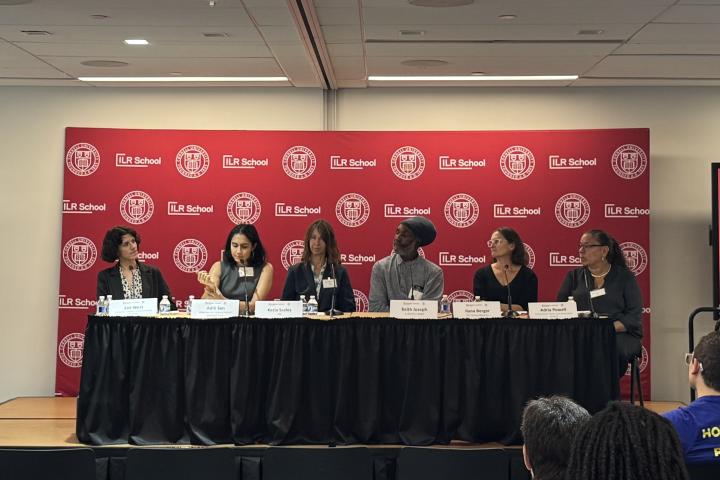
Worker Precarity in Journalism, Academia and Computer Programming

Collective Representation as a Response to Worker Precarity

What do part-time or underemployed workers without health benefits, pensions or job security who work split shifts at a number of different locations each week have in common? They all hold a university degree, often with at least one master’s degree and/or a doctorate, but find themselves in precarious, insecure work.

A man and woman sitting down working together looking at a shared tablet
Worker Precarity in Journalism, Academia and Computer Programming
cornell-seal Icon

About the Institute

The Worker Institute at Cornell engages in research and education on contemporary labor issues, to generate innovative thinking and solutions to problems related to work, economy and society. The institute brings together researchers, educators and students with practitioners in labor, business and policymaking to confront growing economic and social inequalities, in the interests of working people and their families. A core value of the Worker Institute is that collective representation and workers’ rights are vital to a fair economy, robust democracy and just society. Learn more about all of our offerings.

Worker Institute

Core Offerings

The Worker Institute serves as a hub for policy research, publication, and training for policymakers, entrepreneurs, and activists engaged in the public debate to reduce economic inequality.

megaphone

Student Engagement

Student Engagement

The Worker Institute is committed to engaging Cornell ILR undergraduate and graduate students through our courses, research fellowships, graduate programs and other professional development opportunities.


Students on international experience trip
Learn more about our work with students.

In the News

Media Mentions

Temporary Protected Status is set to expire for Haitians. That could be a significant loss to Long Island communities and employers.

Newsday
New York state has 98,250 workers with TPS, most of whom come from Haiti and Venezuela, according to a study from ILR’s Worker Institute.
Temporary Protected Status is set to expire for Haitians. That could be a significant loss to Long Island communities and employers.

Cornell study shows impact of immigrant workers on New York economy and communities

WBNG
The economic and community impact of immigrant workers with Temporary Protected Status in New York state is the focus of a new report from ILR’s Worker Institute, called “We Are Home: Workers with TPS Belong Here.”
Cornell study shows impact of immigrant workers on New York economy and communities

Cornell report shows immigrant, temporary workers contribute to NY economy

FingerLakes1.com
A new report from ILR’s Worker Institute found that immigrants in New York with Temporary Protected Status have strong attachments to their New York communities, are highly engaged in civic and political organizations and view the United States as their home.
Cornell report shows immigrant, temporary workers contribute to NY economy

Workers With Temporary Protected Status Aid NYS’s Economy, Society

Cornell Chronicle
Central Americans with TPS status make significant contributions to New York’s economy and civic and political organizations, an ILR School report says.
Workers With Temporary Protected Status Aid NYS’s Economy, Society

Morning Report: A rough start to the new U.S.-Iran deal

Marketplace
“Diversity is always good business practice, because you bring different voices to a problem … That’s what we’re missing by not being able to track it,” says Patrica Campos-Medina, executive director of ILR’s Worker Institute, about the dropped EEOC requirement for federal agencies to report certain demographic data.
Morning Report: A rough start to the new U.S.-Iran deal

Inside Rainbow's AI clash with its fashion models

Business Insider
A report from ILR’s Worker Institute is quoted in this article about how the use of artificial intelligence by Rainbow, a fashion retailer, has impacted models.
Inside Rainbow's AI clash with its fashion models

Collective Representation as a Response to Worker Precarity in Logistics, Warehousing and Supply Chains

The second webinar in the Cornell ILR Worker Institute's three-part series on collective representation and worker precarity examined how e-commerce, automation, and changing supply chains contribute to worker insecurity in warehousing and logistics, and how collective organizing, legislation, and community solidarity can address these challenges.
overhead shot of warehouse worker pushing boxes with surrounding shelves of packages
Collective Representation as a Response to Worker Precarity in Logistics, Warehousing and Supply Chains

Cornell’s Last Mile Delivery Study Finds Majority of Non-Union Delivery Drivers Would Unionize

Preliminary data from Cornell’s Last Mile Delivery study finds that a majority of its non-unionized package delivery driver respondents think that their interests would be better represented by a union and would support unionization at their employers.
blogphoto
Cornell’s Last Mile Delivery Study Finds Majority of Non-Union Delivery Drivers Would Unionize

The Incursion of Private Equity into New York State Home Care

Findings from a two-year research project that explores private equity’s incursion into home care in New York State, its relationship to structural racism and how agency structure shapes working conditions, worker voice and what this means for quality of care.
RWJF0930
The Incursion of Private Equity into New York State Home Care

Lois Gray Innovation Initiative 

Explore the Initiative
Lois Gray, ILR School faculty member

The Lois Gray Innovation Initiative was founded by labor pioneer Lois Gray to generate innovative thinking and solutions to problems related to work, economy, and society. The Lois Gray Innovation Fund provide financial incentives for collaboration between resident and extension faculty in relation to priority programs of The Worker Institute. It ensures faculty, researchers and students have the opportunity to fulfill the institute’s mission of advancing worker rights and collective representation.