Cornell’s Last Mile Delivery Study Finds Majority of Non-Union Delivery Drivers Would Unionize
Preliminary data from the Last Mile Delivery study at Cornell University’s School of Industrial and Labor Relations finds that a majority of non-unionized delivery drivers would join a labor union and think that their interests would be better represented by a union. Last-mile delivery refers to the last step of the shipping process where a package moves from a local distribution center directly to the customer's home or business address. The following questions were asked of respondents who are not members of a labor union at their last mile delivery jobs; 76.2% (n=574) of respondents reported that they are not members of a labor union.
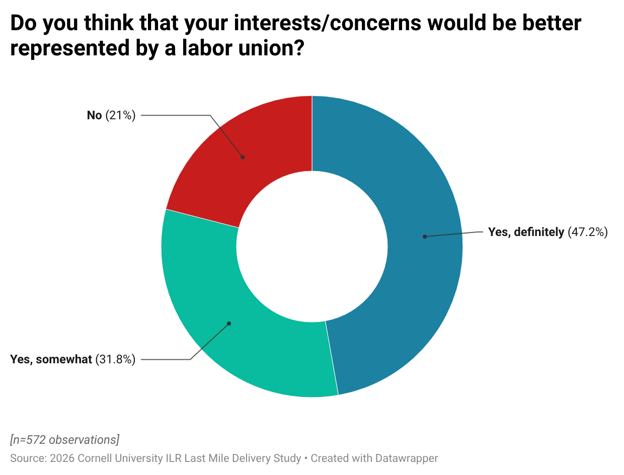
When asked if they thought that a labor union would better represent their concerns and interests, 47.2% (n=270) of respondents responded “Yes, definitely” and 31.8% (n=182) responded “Yes, somewhat,” for a total of 79%; the other 21% (n=120) responded no.
[1] Data collection for this project is still ongoing. Data reported in this post are current as of October 15, 2026.
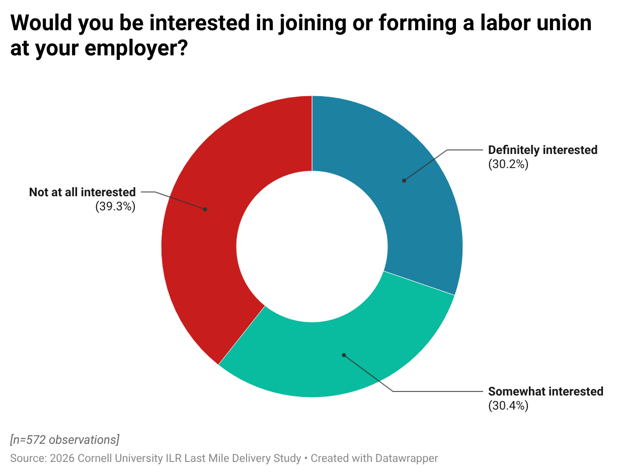
Similarly, A majority would be interested in joining or forming a labor union at their employer, including 30.2% (n=173) who responded “Definitely interested” and 30.4% (n=174) who responded “Somewhat interested”; 39.3% (n=225) responded “Not at all interested.”
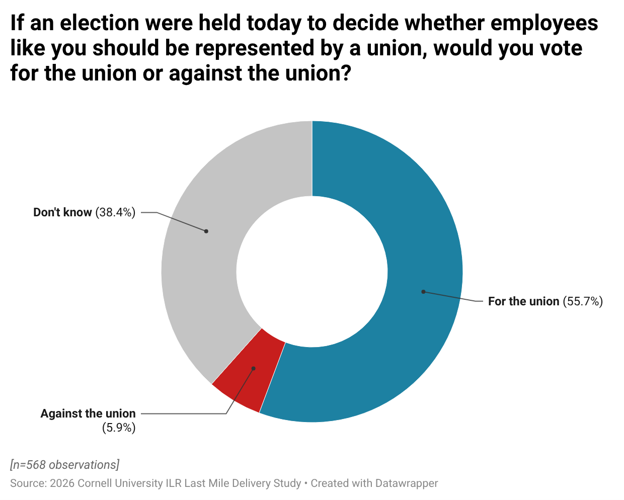
When asked if an election would be held today, 55.8% (n=319) would vote for the union and 5.9% (n=34) would vote against; 38.4% (n=220) responded that they are unsure if they would vote for the union.
Notably, opposition in the earlier questions did not necessarily translate to a willingness to vote against a hypothetical union election. 68.4% (n=154) of respondents who said that they were not at all interested in joining or forming a labor union at their employer responded “don’t know,” when asked if they would vote for or against a union at their employer; only 11.1% (n=25) of respondents who responded that they were not at all interested in joining or forming a labor union at their employer also indicated that they would vote against the union while 20.4% (n=46) would vote for the union. Similarly, 78.33% (n=219) of respondents who said that they did not think their interests wouldn’t be better represented by a labor union responded “don’t know” when asked if they would vote for or against a union at their employer; 20% (n=24) of respondents who answered no said that they would vote against the union and only 1.7% (n=2) of respondents who indicated no said that they would vote for the union.
This high level of uncertainty about voting for or against the union in an election suggests that respondents may not fully understand what unionization would entail, may fear potentially negative impacts of unionizing, and/or that more information may be needed before making a decision, such as which union one may be joining or what doing so would mean for their pay, benefits, and job security, among other factors. Further, unionization in this sector can be tricky, due to subcontracting, such as Amazon’s Delivery Service Partner (DSP) model. In the DSP model, a business owner can partner with Amazon to lease out delivery service areas. Under this model, employees are formally employed by the partner, rather than by Amazon directly, even though Amazon still retains substantial control over employees’ work through its use of app-based algorithmic management. Some workers may also be independent contractors, rather than employees, who are not typically eligible to join unions under the National Labor Relations Act (NLRA).
ABOUT THE LAST MILE DELIVERY STUDY:
The Last Mile Delivery Study is a National Science Foundation-funded collaboration between the Institute for Compensation Studies, the Buffalo Co-Lab, and the Worker Institute at Cornell University’s School of Industrial and Labor Relations, and industry expert, Steve Viscelli. Data for this study were collected during summer 2026 in two states, one with high and one with low union density, by canvassing last mile delivery drivers. Respondents completed an online survey about their wages, benefits, workplace safety, and other working conditions.