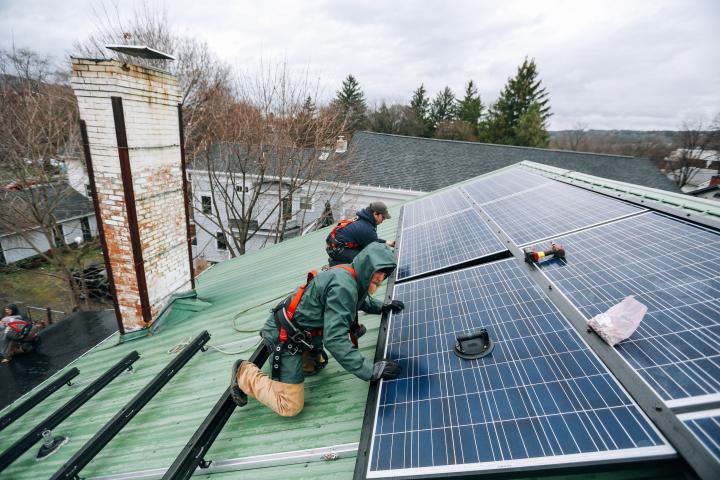

Q&A with Reyna Cohen, lead researcher of CJI’s New Pennsylvania Report
"The landscape of climate action in Pennsylvania paints the picture of a state that threatens to be left behind in the next great economic revolution. Or, seen another way, a state with lots of room to grow, experiment with innovative policy, and become a leader once again.”
Another leading-edge state report from The Climate Jobs Institute (CJI) reveals how the heart of coal country now beats for a clean-energy future, one Pennsylvanians desperately need. Poverty wages, archaic policy, crumbling infrastructure—the transition to a renewable energy economy lies on a wire. But Pennsylvania, resource-rich and equipped with a robust energy workforce, could become a leader in the green economy. If the report’s 26 recommendations are realized, the state will see over 800,000 new jobs in the next six years.
We spoke to Reyna Cohen, the report’s lead researcher and CJI’s research and policy development associate, whose biopsy lays bare the Commonwealth’s failures in the face of converging crises–climate, economy, inequity—and the way forward.
This report offers insights across several sectors: energy, industry, buildings, transportation, agriculture and infrastructure. What common themes emerge?
RC: The most evident theme of the report is just how behind Pennsylvania is with its climate policy, especially climate policy that uplifts workers, low-income communities, and Black Indigenous People of Color (BIPOC) communities.
The Commonwealth’s most notable climate policy is its Alternative Energy Portfolio Standards Act, adopted nearly 20 years ago and only requiring that a small fraction of the state’s energy be produced from renewable sources. For context, nearly half of all states have both net-zero emissions targets and 100% clean energy targets, including Pennsylvania’s neighbors New York, New Jersey, Delaware, and Maryland. Moreover, the policy lacks any labor standards, and many of Pennsylvania’s unions have taken significant issues with it.
Altogether, the landscape of climate action in Pennsylvania paints the picture of a state that threatens to be left behind in the next great economic revolution. Or, seen another way, a state with lots of room to grow, experiment with innovative policy and become a leader once again.
A core tenet of our report is how well Pennsylvania is set up to become a leader in the green economy because of its wealth of resources: its highly-skilled fossil fuel workforce and infrastructure, its union training programs, its industrial strength, existing community advocacy, etc. Throughout our research, we really focused on how each of these aspects is key to a just and equitable transition in the Commonwealth.
Pennsylvania’s infrastructure is woefully inadequate, from its grid to its public schools to its bridges, dams, and water pipes. This report underscores how an equitable and union-green transition in the state means revolutionizing its infrastructure to ensure health and safety for all Pennsylvanians. I want to stress just how powerful climate action can be in the Commonwealth. If all 26 of our recommendations were adopted, Pennsylvania would see over 800,000 new jobs in the next six years or nearly 13% of the state’s entire working population. That alone should prove how powerful this report is.
What are the key takeaways for policymakers reading this report? How might an actionable follow-through look?
RC: Policymakers should know there is a large coalition of support in Pennsylvania for passing good climate policy that meets science’s demands and provides high-quality union jobs with family-sustaining wages. This coalition is not metaphorical; it is very real. Leaders like Rob Bair, president of the Pennsylvania State Building and Construction Trades Council, and co-lead of the Climate Jobs Pennsylvania coalition, have helped bring together stakeholders across the state. Together, labor, environmental, and climate movements have helped inform a Blue-Green legislative agenda for the state’s newly-emerged Blue-Green Caucus in the House of Representatives.
The 11 bills making up this legislative agenda are just the start. Each of our report’s 26 recommendations delivers on the promise of bringing climate jobs and justice to the Commonwealth’s green energy economy. From commitments to building 54.5 Gigawatts of renewable energy, rapidly expanding and electrifying Pennsylvania’s public transit, and transforming the Commonwealth’s aging and hazardous school infrastructure into healthy and sustainable learning environments, this report emphasizes equitable climate policy that uplifts the working Pennsylvanians. This must be front and center for Pennsylvania’s policymakers.
The biggest takeaway for policymakers is that Pennsylvania’s labor movement stands behind climate action, stands behind building out a renewable energy economy, stands behind decarbonizing its industrial sector, its buildings, and its transportation. In short, Pennsylvania’s labor movement stands behind an equitable green future for the Commonwealth’s economy.
Pennsylvania has some of the greatest income inequality in the United States. For Pennsylvanians who are tied up in securing basic needs such as housing, childcare, healthcare, gas, food, etc., why does this report deserve their immediate attention?
RC: Pennsylvania’s existing economy is failing so many Pennsylvanians. In addition to the immense income inequality across Pennsylvania, which creates an enormous gulf between the Commonwealth’s working class and its wealthiest members, we also see dramatic inequality in income by race and gender in the state. Moreover, for up to 39% of Pennsylvania households, even basic needs such as housing, transportation, food, healthcare, gas, energy, and childcare are unaffordable.
Because of its status as a “threat multiplier,” the climate crisis will make every one of these problems worse. This is especially true for frontline communities who face the impacts of the crisis first, worst, and with fewer resources to bounce back quickly.
Our research tries to answer the question, ‘How do we not only protect communities from the climate crisis but begin to reverse inequality and uplift communities economically–all at the same time?’ The way we answer that in the research is by pushing the most ambitious climate policy possible, policy that meets the needs of science and guarantees that the new, green jobs are union jobs, accessible to all, and with clear career pathways into these industries.
The overarching mission of our Pennsylvania report–and our work at CJI as a whole–is to link climate action with a more equitable and just economy. More than a climate change report, this is really a jobs report. That’s why we hope everyday Pennsylvanians engage with it.
The minimum wage in Pennsylvania is $7.25 an hour. This report discusses prevailing wages and unionization to promote a fairer future. How exactly do these mechanisms bring greater equity to the Keystone State?
RC: Pennsylvania’s $7.25 minimum wage matches the federally mandated minimum wage, which is far below what is commonly referred to as the “living wage.” A “living wage” is how much workers must earn in order to afford basic needs such as food, transportation, and housing. MIT’s living wage calculator puts Pennsylvania’s “living wage” floor at $21.95/hour. Moreover, this calculator defines Pennsylvania’s current minimum wage as only one cent above the poverty wage. The federal poverty level is $15,060 per year; Someone working full-time at Pensylvania’s current minimum wage would make just $20 above that ($15,080).
One way to combat this inequity is through a prevailing wage. The prevailing wage is a policy mechanism that requires a minimum pay rate much higher than the minimum wage for construction workers on public works projects.
Prevailing wage requirements ensure that contractors with highly skilled workers can bid competitively on public works projects without being underbid by contractors that pay poverty wages and do not provide robust benefits like healthcare and retirement.
In the report, we also discuss how unionization is key to fighting many inequities, including access to training, benefits, and family-supporting wages. Just over half of private sector employers in Pennsylvania offer any form of health coverage to employees. But employer-provided healthcare is a given in union contracts. Union membership also opens doors to higher pay for women and BIPOC; under union contracts, employers must follow fair and transparent systems for compensation, promotions, hiring and firing. Median wages for non-union workers are only 86% of what their union counterparts earn, without accounting for benefits. In 2023, median wages for unionized women were nearly $200/week more than nonunion women, or almost $10,000 more per year.
In recent news, scientists from the University of Pittsburgh discovered a large amount of lithium in Pennsylvania. How might this discovery and future events with similar ramifications leverage CJI’s report?
RC: Yes, the Pennsylvania research team (and all of CJI) was abuzz with this very exciting news! This discovery really epitomizes a lot of the work we did with the Pennsylvania report. So much of what we think about when we approach a new state report is how to move from strength to strength, especially for a state like Pennsylvania with such a rich history in the labor movement, in the fossil fuel industries, and in the industrial sector. In other words, how can we leverage existing cornerstones of the Pennsylvania economy to pilot innovative policy and propel the Commonwealth into a position as a leader in our green energy future?
For instance, in the fourth recommendation of the report, we explored alternative uses for natural gas wells and the union workforce that helped create this infrastructure. Capping these wells will mitigate methane leakage–methane being an extremely potent greenhouse gas–and there’s even potential to reuse these wells to produce renewable geothermal energy. This work is a natural fit for workers already familiar with this infrastructure, providing a place for them in the green economy where maybe they didn’t think there was one before.
Similarly, recommendation 25 talks about repurposing abandoned mines for new jobs and new technologies, including their potential for solar installations or energy storage. Recommendation 10 encourages the state to use thermal energy networks to decarbonize public buildings, public housing, and affordable/low-income housing, leveraging the already-existing skillsets of utility workers and pipe tradesmen–and maybe even the preexisting infrastructure–to push towards a greener future.
This report evidences Pennsylvania’s dual crises: climate change and inequality. Since 2024 is an election year, why is it important that these crises remain a bipartisan, unpoliticized issue?
RC: The climate crisis is not one single issue among a myriad of others we talk about during election season: the economy, education, healthcare, immigration, inequality, and on and on. The climate crisis is unique in that it is the umbrella under which all other issues fall.
This is especially true in the context of the economy. We often see climate action juxtaposed with jobs, the economy, and the labor movement as if there is some trade-off between the two. But as you see across all of CJI’s work, this is simply not the case. In fact, the legacy of the “Just Transition” came out of the recognition that the labor movement, that workers overall, must be centered in environmental and climate policy since they’re on the front lines of these crises.
In each of our state reports, we are laser-focused on demonstrating just how important passing equitable, just climate policy is to creating a thriving economy, preserving jobs, protecting the working class, and rebuilding the middle class—none more so than the Pennsylvania report.