States' Response to Weakening of Federal Labor Protections Examined in Co-Lab Learning Session
Session Spotlights Opportunities for Labor Law Reform
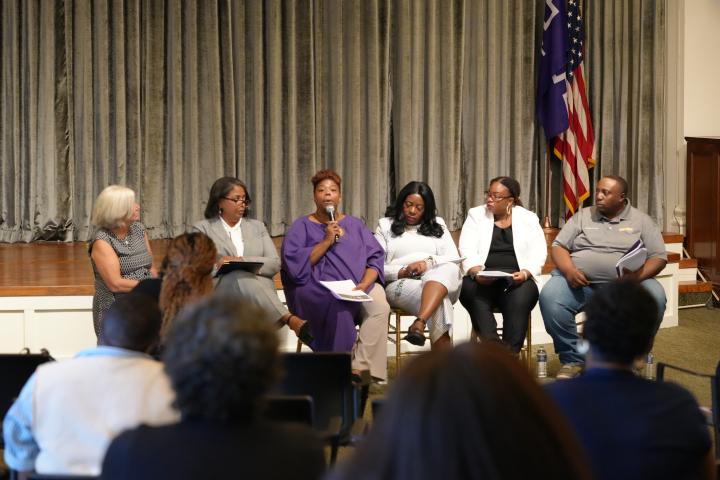
During a learning session with young people and labor leaders in Buffalo, New York, Cathy Creighton, Director of the ILR Buffalo Co-Lab, and Claire Sellers, Partner at Hayes Dolce LLP, examined the current state of the American labor movement, the growing shortcomings of the National Labor Relations Act (NLRA), and the ways several states are responding to the weakening of federal labor protections.
Congress enacted the National Labor Relations Act in 1935, establishing for the first time the legal right of most private-sector workers to organize unions and bargain collectively over wages, hours, and working conditions. The impact was immediate. Union membership grew from approximately 11 percent of the workforce in 1934 to 32.4 percent in 1945, representing an increase of more than 10 million union members.

As workers gained bargaining power, wages and benefits improved substantially. Today, union workers earn, on average, between 11 and 15.9 percent more than comparable nonunion workers, while unionized women earn more than 23 percent more than their nonunion counterparts. A strong labor movement has historically ensured that workers shared in rising productivity and corporate profits, helping to build and sustain America's middle class. Labor organizations also played a central role in advancing civil rights, workplace safety, Social Security expansion, Medicare, and other major public policy initiatives.
Business interests responded to labor's growing influence by pressing Congress to limit unions' power. In 1947, Congress enacted the Taft-Hartley Act, amending the NLRA and imposing significant new restrictions on labor organizations. Although total union membership continued to increase—reaching more than 20 million workers in 1979—union density has steadily declined since the passage of Taft-Hartley. By 2022, private-sector union density had fallen to its lowest level since before the NLRA was enacted, and it has continued to decline through 2026.
As workers' bargaining power has diminished, wealth has become increasingly concentrated at the top of the economic ladder. The weakening of organized labor has coincided with widening income inequality and a shrinking share of national income flowing to working people.
An increasingly antiquated federal labor law has contributed significantly to the labor movement's diminished effectiveness. While these structural weaknesses have existed under both Democratic and Republican administrations, President Trump's second administration has accelerated the erosion of federal labor protections. Among other actions, the administration has removed members of the National Labor Relations Board viewed as supportive of workers, leaving the Board without a quorum; reduced the agency's budget; supported legal arguments asserting that the NLRB is unconstitutionally structured; and withdrawn collective bargaining rights from approximately one million federal employees.
With private-sector union density now at just 5.9 percent among workers covered by the NLRA, organized labor has lost much of the political influence necessary to secure meaningful federal labor law reform. Despite repeated efforts over the past five decades, Congress has failed to enact comprehensive labor law reform.

In response, several states—including New York, California, Massachusetts, and Washington—have begun adopting laws designed to protect workers when the federal system is unavailable or ineffective. These laws generally allow private-sector workers to seek relief before state labor relations boards if the NLRB is unable to function or if federal labor protections are otherwise unavailable.
Following New York's enactment of its law, both Amazon and the NLRB filed lawsuits challenging the statute. The NLRB argues that federal labor law preempts New York's legislation and that the Board retains exclusive authority over most private-sector labor relations. Amazon likewise contends that New York's law is unconstitutional and argues that employees alleging unfair labor practices should instead seek relief before the NLRB. Yet in separate litigation, Amazon has argued that the NLRB itself is unconstitutional, creating the unusual position that workers should rely exclusively on an agency that the company simultaneously contends lacks constitutional authority. In essence, Amazon argues that if it violates labor law, its workers have no where to go to object!
The session concluded with a discussion of several important questions. If the federal system continues to weaken, where does that leave American workers? What legal and political options remain available to the labor movement? What are the advantages and disadvantages of pursuing a state-by-state strategy? And how are the nation's leading labor organizations responding to these rapidly changing circumstances? Cathy and Claire will consider offering a similar presentation to other central labor councils around the US. If you are interested, please contact Cathy Creighton at cathycreighton@cornell.edu