AI and the New Informality
A New Research Focus at Global Labor Institute
Most conversations about AI and labor concentrate on displacement: will AI take your job, and which sectors are most exposed? These are important questions. But instead of focusing only on whether AI is taking your job, we feel it’s important to also ask: what happens to your job if it doesn’t?
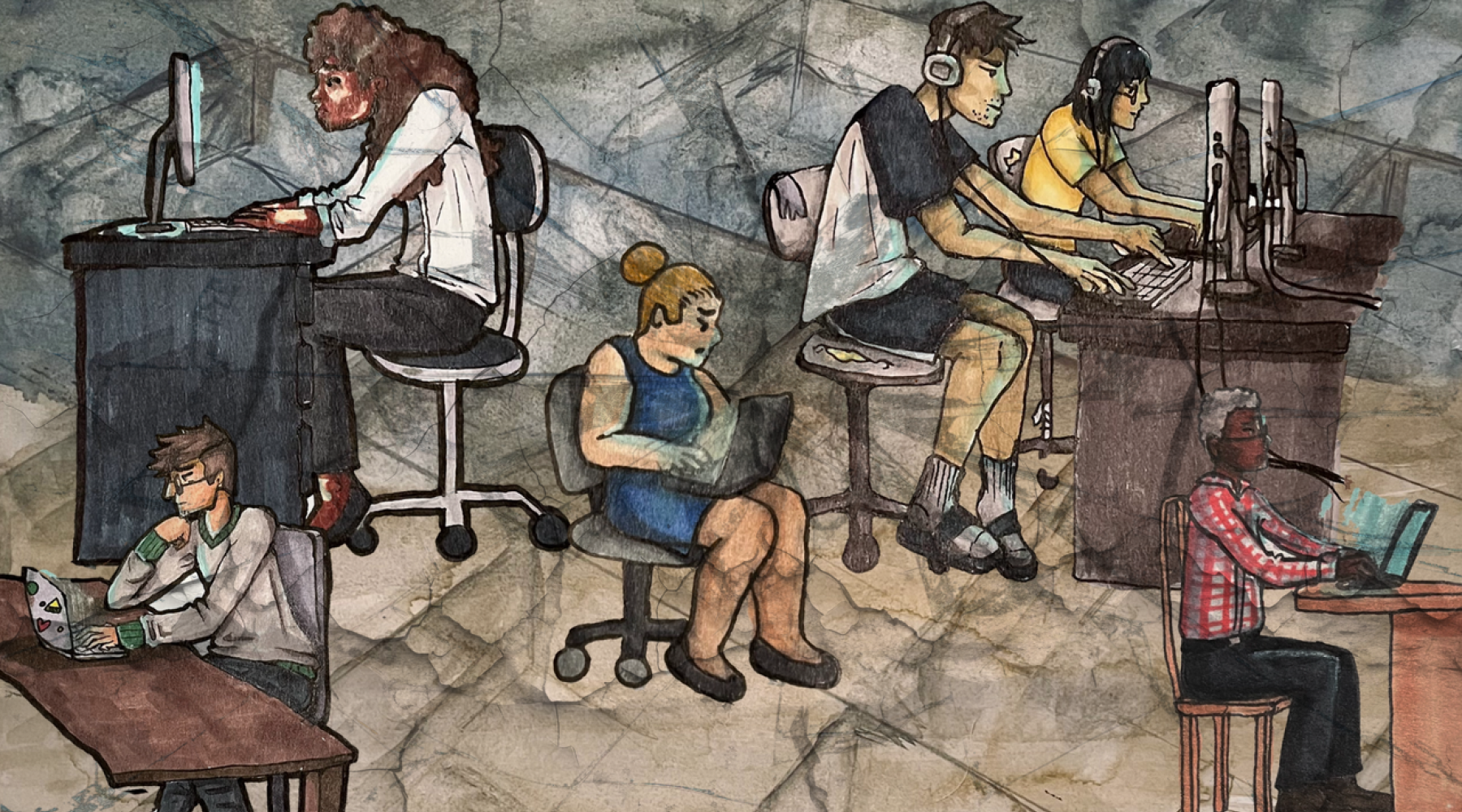
Imagine you are a graphic designer with decades of experience. You remain a salaried employee, but AI generates most of the content you produce based on current trends and audience engagement. Rather than doing creative research and delighting in choosing just the right typeface, you are assigned small validation tasks through an internal platform, evaluated by productivity metrics, and instead of putting on your noise-cancelling headphones and settling in for deep work and creative problem-solving, you are rotated rapidly between projects. Your title and contract stay the same. Your autonomy, professional judgment, and relationship to the organization do not – your experience of work increasingly resembles platform labor instead.
This is not simply automation. It is something different.
It prompts larger questions about what happens when workers remain employed, but their autonomy narrows day to day. What happens when their professional judgment is reduced to correcting or validating AI-generated outputs and stable work is reorganized into project-based tasks, platform-mediated assignments, or contractor-like arrangements? Or when organizational accountability becomes blurred, professional recognition declines, and the protections that once made employment meaningful begin to thin out?
These are the questions behind our new research agenda on AI and the New Informality.
Formal versus informal
Formal employment has never meant simply having a paycheck. Alongside that paycheck is typically a bundle of protections: a contract, predictable income, social protection, collective voice, and visibility to regulators. It also carries professional recognition – the sense that one’s skills, judgment, and contributions matter in their field.
Informal work, by contrast, has usually been understood as work outside these protections: day labor, undeclared work, casual labor, subcontracting, or platform work where workers may sign commercial contracts but lack employer-paid protections, collective agreements, or meaningful control over when work comes in and when it stops.
That was one wave of informality. What we are interested in is another: informalization happening inside formal employment itself.
A ratchet or a dial?
This raises a larger policy question: is formal employment as secure a category as labor policy has often assumed? Labor policy has long assumed economies move one direction: informal toward formal. But can we expect that to continue as more organizations onboard AI into teams, restructure tasks, and devalue some forms of human contributions? Formalization has often been treated as a ratchet: hard to win, but once won, secure. AI may be revealing that it is closer to a dial, one that can be turned back.
AI-driven informalization
As we define AI-driven informalization through this new research agenda, we do not mean generic precarity, all non-standard work, or simple automation displacement. We mean something more specific: a job that remains formal on paper while the markers that made it formal – contract security, social protection, voice, visibility, accountability, autonomy, and recognition – quietly drain away as work is reorganized around AI.
This process is difficult to detect because many of our institutions were not built to see it. Employment statistics tell us whether someone has a job, not whether that job has lost autonomy, stability, accountability, or professional meaning. Labor law often asks whether someone is an employee or a contractor, but it does not always capture workers whose formal status remains intact while the protections around their work begin to thin.
Take what happened at Videogamer.com, a 20-year-old U.S. company that reports on videogames. After the company had been sold to new owners who were interested in driving greater efficiency in the writing department, 20 members of the writing staff were fired and instructed to reapply for new roles where they would be training AI ‘writers’.
Workers in roles like these often find themselves hired back into an isolated environment where they log into a platform like Slack to be given training tasks with little to no connection to managers, colleagues, or HR. The case is striking because it shows how AI can reorganize the relationship between workers, firms, and the work itself: the occupation does not disappear, but the terms under which people contribute to it begin to change.
We cannot conclude that AI inevitably produces worse jobs. AI can augment work, but whether AI improves work or erodes it depends on how it is introduced, and what tools exist to protect workers when tasks, roles, and responsibilities are reorganized.
AI-driven informalization is not only about workers training AI systems. It can also happen while formal employment remains intact. In journalism, AI-generated content may allow a newsroom to retain a smaller group of editors while shifting other journalists into freelance or per-piece arrangements, with fewer guaranteed hours, weaker benefits, and less collective protection. In legal services, AI-assisted research may eliminate salaried associate roles and push lawyers into project work through intermediaries, weakening both the employment relationship and the professional development pathway. In translation, the loss of agency contracts to AI-powered tools may push workers toward irregular referrals or undeclared work, outside contract, social protection, and regulatory visibility.
Taken together, these examples point to the same problem: AI may hollow out formal employment from within, weaken protections in existing roles, push professionals into precarious transitions, or move work outside formal visibility altogether. Broader changes to workplace benefits, such as recent cuts at firms investing heavily in AI, raise the same question. Deloitte, for instance, recently shrank parental leave from 16 weeks to 8, cut PTO by up to 10 days, and removed a $50,000 benefit covering adoption, surrogacy, and IVF. Around the same time, Zoom cut its own parental leave, from 22–24 weeks down to 18 for birth parents. We cannot always prove a direct causal link in these cases, but the timing highlights the importance of systematically tracking whether AI adoption and the erosion of employment protections travel together.
Our research agenda
The philosophy behind our research is simple: start from workers’ lived experience, not employment and productivity statistics alone. We ask what actually happens to contracts, protections, autonomy, accountability, and recognition when AI enters professional work.
We compare experiences across the Atlantic and along global supply chains because similar technological pressures land on very different institutional ground in the United States and Europe, and because AI-driven restructuring often moves through outsourced, subcontracted, and platform-mediated networks. We aim to build knowledge that institutions can use: helping unions, regulators, policymakers, and worker organizations see a process that today’s statistics and legal categories often miss.
If jobs can be informalized, they can, in principle, be re-formalized. We’re eager to find out.
For more information or to engage with this research agenda, please contact: globallaborinstitute@cornell.edu