



Overview
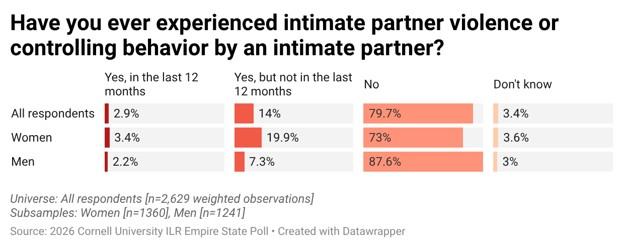
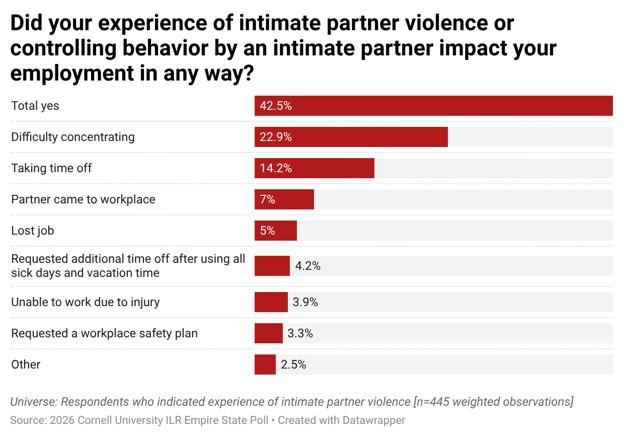
The 2026 Empire State Poll (ESP) found that 16.9% of respondents have experienced intimate partner violence in their lifetimes, including 2.9% who have experienced it in the past year. Of the respondents who have experienced intimate partner violence, 42.5% said the violence impacted them in the workplace in some way, including difficulty concentrating, needing to take time off, the abusive partner coming to their workplace, losing their job and not being able to work due to an injury.
Employers and unions can offer support and provide accommodations to protect victims from further abuse.
Background
The workplace impacts of intimate partner violence are often overlooked, with potentially grave consequences. While it is common to assume that violence only occurs in the home, both violence and controlling behavior can show up in a variety of places, including the workplace.
An abuser may excessively call or text their victim at their work. They may come to the victim’s workplace to surveil or ask others to participate in the surveillance. In cases where the victim has fled their abuser and found another place to live, the abuser may use the victim’s workplace to locate them, making the victim vulnerable to further stalking, harassment, intimidation, assault or even murder.
Interventions in the form of support and accommodations from employers and unions can help victims leave abusive situations and protect them from further violence and harassment.
Key Findings
- More than 1 in 10 (16.9%) of ESP respondents indicated having experienced intimate partner violence in their lifetimes, including 2.9% who have experienced it in the last 12 months. Further, 3.4% indicated being unsure if they have experienced intimate partner violence.
- Of those respondents who have experienced intimate partner violence, 42.5% indicated that the violence impacted them in the workplace in some way.
- These workplace impacts included difficulty concentrating at work, taking time off from work to address matters related to intimate partner violence – such as court appearances and medical appointments. The impacts also included the abusive partner coming to their workplace, losing their job and not being able to work due to an injury.
- Employers and unions should educate their employees and members on recognizing intimate partner violence and how it can show up in the workplace.
- Employers and unions can increase the victim’s safety by developing workplace safety plans and providing accommodations, such as worksite changes, schedule changes, remote work and increased security.
- Employers and unions should support victims by providing emergency funds and the necessary time off to address their needs, such as court appearances and medical appointments.
Research Impact
More than 4 in 10 respondents (42.5%) with a history of intimate partner violence report that it impacted them in the workplace in some way. While intimate partner violence is often thought of as a private issue, its impacts can follow the victim to the workplace, even if they have left the home and/or abuser. This finding underscores the importance of providing accommodations for victims to make them safer and to permit them to continue working as they transition to the next chapter of their lives.
Statistics
Authors
Anne Marie Brady is the Senior Extension Associate – Research Director, Worker Rights and Equity. Anne Marie holds a Ph.D. in Social Policy Research from the London School of Economics and Political Science (LSE). She served as the research director for this report. Michael Lenmark is a Senior Research Support Specialist at the Worker Institute and the survey statistician for this report.

CONTACT:
Ariel Avgar
Director
aca27@cornell.edu
The Center for Applied Research on Work exists to connect research on work with the practice of putting it to use. We support member institutes and affiliated faculty and students in their efforts to take insights about work, labor and employment and share them broadly. We are uniquely placed to seed innovative research that puts academic study into practice.